Father Jesús Villagrasa, L.C., who participated in the 2026 General Chapter, reflects on the profound relationship between authority, obedience and fraternal life within the Church and consecrated life, proposing a model based entirely on the figure of Jesus Christ.
We are sharing the full article, published by the Mexican Office of Communications. The original article is available here.
Looking at our recent history as a congregation is to contemplate a path of grace and renewal that always involves a continuous conversion to the Gospel. Those of us who have embraced this vocation know well that the 2026 General Chapter was a moment of particular grace, as Pope Leo XIV told us.
“A privileged moment of community discernment and listening to the Holy Spirit, who continues to guide its history and sustain the mission entrusted to its congregation, in fidelity to the charism received as a gift from God for the Church.”
Already in the General Chapter of 2014 we saw that one of the issues that required review and changes was the exercise of authority: In recent years we have been deepening a more comprehensive understanding of compliance with norms to move towards a horizon that relies more on the discernment and personal responsibility of each brother.
On this path of review and renewal, rediscovering the true evangelical meaning of authority and obedience is not only a legal necessity, but a spiritual urgency. Christ himself is presented to us as the absolute model where both realities cease to be opposite and merge into a single mystery of love and surrender to the will of the Father. In light of the recent chapter document and the constant reflection on our identity, I want to dwell on what I consider the two columns that support this evangelical ideal: the moral authority of the superior and the sanctity of life of the religious.
I’m leaving out some very important points from the statement, but I’m encouraged to develop this focus by the letter from the Director General, signed on the Solemnity of the Ascension:
“The Chapter wanted to delve deeper into the theme of authority and obedience as a decisive dimension of our evangelical life. Authority, lived in the way of Christ, is only understood as spiritual and fraternal service. It requires closeness, listening, discernment and decisions made with charity and truth. Obedience, lived evangelically, cannot be reduced to passivity either because it has as its source the generous gift of self. It is a form of interior freedom since it helps us to “listen to God, let ourselves be guided by the Spirit and walk in communion. When authority and obedience are lived like this, unity is strengthened, trust grows and the mission becomes more fruitful. I encourage you to read and pray the Chapter Communiqué and to take it in community to fraternal dialogue and to the community project, to translate it into concrete decisions.”
May this prayerful reading fill in the many rich points of the statement that I cannot even begin to outline.

The moral authority of the superior: beyond the position or function
Governing a religious community is a pastoral service necessary for the health of any community. However, experience shows us that the exercise of authority runs the risk of being sterilized if it is reduced to mere administrative management or a merely functional role. The power that a superior receives has its legal roots in the Church, but its true pastoral fruitfulness and its ability to be welcomed with peace depend directly on its moral authority, that is, on its sanctity of life.
The authority of Jesus Christ as head coincides with his service, his gift, his total, humble, and loving dedication to the Church. We are a clerical religious congregation and, in addition to observing a religious vow, we are configured to Christ, head and shepherd. The priest’s “power” is “spiritual” and “sacred,” a participation in the authority with which Jesus Christ guides the Church. The authority of Jesus Christ as head coincides
“With his service, with his gift, with his total, humble and loving dedication to the Church. And this in perfect obedience to the Father: he is the only true suffering servant of the Lord, priest and victim at the same time. This specific type of authority, that is, service to the Church, must animate and vivify the spiritual existence of every priest, precisely as a requirement of his configuration with Jesus Christ, head and servant of the Church” (John Paul II, Pastores dabo vobis 21).
An authority of this type is unique in the world, since the ordained minister
“He governs with the heart of the humble servant and the affectionate shepherd who guides his flock seeking the glory of God and the salvation of souls” (John Paul II, Pastores gregis 43).
For a superior to truly be a reflection of the Good Shepherd, his leadership must be built on certain key evangelical attitudes:
- Being a witness before being an administrator: His moral authority stems from the witness of a holy life and charity lived firsthand. If a superior does not consistently live what he teaches, he ends up transmitting a contradictory message that weakens the trust of his brothers.
- Accompanying with a compassionate gaze: He is called to master the “art of accompaniment,” removing his shoes before the sacred ground of the other, listening with hospitality, and going out to meet the troubled soul.
- Fostering subsidiarity without diluting his responsibility: Good governance does not concentrate everything in itself; it knows how to delegate, trusts in the abilities of the brothers, and actively engages in dialogue with them. But, at the same time, it is not afraid to make clear and timely decisions when the common good or the mission demands it.
- Avoiding the deviations of power: The lack of authentic spirituality can lead the superior to fall into rigid authoritarianism, subjective personalism, or paternalism, which hinders the religious’s maturity. or, in a negligent passivity that avoids conflicts for the sake of convenience.
When the superior governs with a servant’s heart, the religious do not see him as a bureaucratic boss, but as a human and close channel —with his logical limitations— of the Father’s own will.
The holiness of the religious person: an active, free and mature obedience
Furthermore, the obedience of a religious person cannot be understood as a passive or blind submission that negates the individual. Like Christ’s obedience in Gethsemane, our obedience is a supreme act of filial freedom. It is an offering of one’s own will that does not impoverish the person, but rather enriches them and leads them to their fullest maturity.
The sanctity of the religious is played, to a large extent, on how he incarnates this vow in the daily community life:
- Active and sincere search for God: The holy religious does not carry out orders mechanically without thinking; he is a constant seeker of what God wants, making use of personal discernment that springs from a rightly formed conscience, free from disordered attachments. It is no coincidence that the Vatican document most cited in the chapter statement on our topic is “The Service of Authority and Obedience” of May 11, 2008, which, in its first paragraph, wisely places the topic in its proper context: “While in the community everyone is called to seek what pleases God and to obey Him, some in particular are called to exercise, generally temporarily, the specific office of being a sign of unity and a guide in the collective search for, and personal and communal fulfillment of, God’s will. This is the service of authority.”
- Shared responsibility and dialogue: Holiness impels us to participate positively in community life, contributing our natural gifts and those of grace to build up the Church. This includes the right, and sometimes the duty, to express our opinions and concerns with humility and respect in the face of difficult commands.
- Overcoming individualism: Living the vow holyly protects us from the “pseudo-freedom” of those who only obey when the guidelines coincide with their personal tastes, or from systematic criticism that destroys the bridges of fraternal trust.
When the moral authority of the superior and the religious’s search for holiness meet, the legionary community is transformed into a true family of seekers of God and his will. Community discernment ceases to be a mere democratic consultation or a search for human consensus and becomes a privileged space where we all, united in the same spirit, try to listen to the Holy Spirit.
In the end, both the one who guides and the one who obeys participate in the same oblation of love of Jesus Christ. May this time of renewal find us with our sandals taken off before the sacred ground of the brother and the superior, with an open heart and the firm desire that our communities be a living and transparent reflection of the charity of the Good Shepherd.
About Fr. Jesús Villagrasa, L.C.
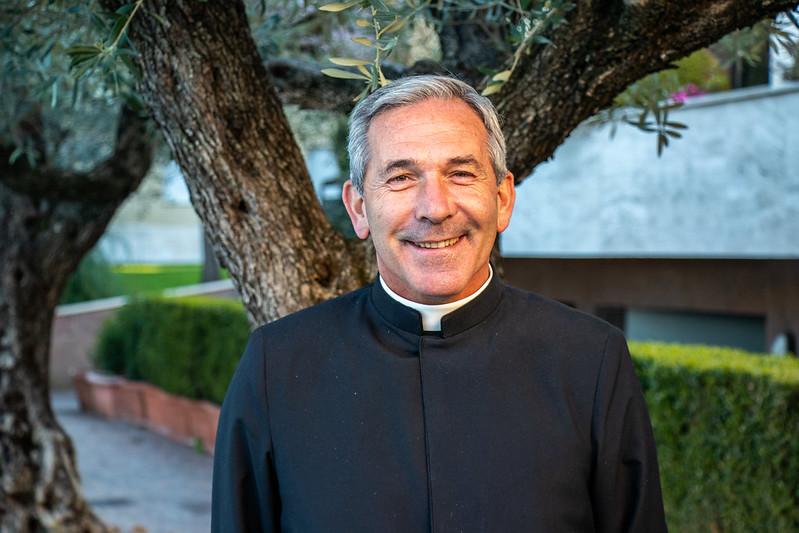
Fr. Jesús Villagrasa, L.C., was born in 1963 in Zaragoza, Spain. He entered the Legion of Christ Novitiate in Salamanca on September 15, 1981, and made his perpetual profession on October 8, 1989. He was ordained a priest on November 25, 1994. He holds a doctorate in philosophy, a licentiate in theology, and a licentiate in bioethics. Since 1999, he has been a full professor of metaphysics in the philosophy faculty of the Regina Apostolorum Pontifical Athenaeum. He served as director of the Quality Office and the Evaluation Center of the Regina Apostolorum Pontifical Athenaeum (2009-2013). On January 31, 2011, Cardinal Velasio De Paolis appointed him a general councilor, a position to which he was confirmed by the 2014 General Chapter.
He has been in charge of monitoring the Regnum Christi network of schools and universities and served as rector of the Pontifical Athenaeum Regina Apostolorum from 2013 to 2019.
On February 7, he was re-elected by the 2020 General Chapter as general councilor of the Legionaries of Christ.
He is currently the rector of Anáhuac University in Mexico.
Cover image: Unsplash