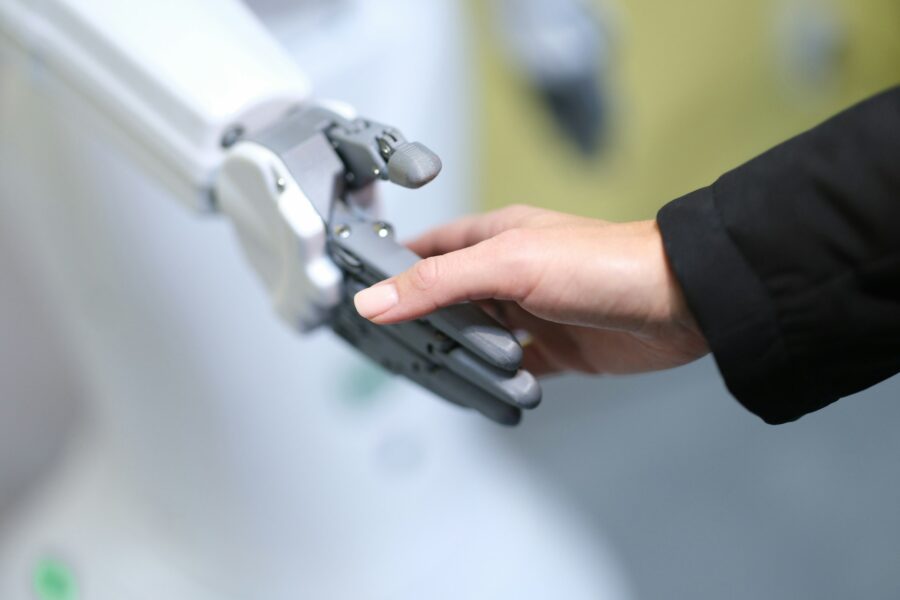
Magnifica Humanitas, the first encyclical of Pope Leo XIV, published on May 25, warns that AI is not merely a technical tool, but a reality that is transforming work, education, human relationships, and our very understanding of the human person. Faced with the risk of a culture dominated by efficiency, data, and technological power, the Pope reaffirms the centrality of the human person, their freedom, conscience, and capacity to love.
The encyclical also recognizes the enormous opportunities that technology offers for health, research and human development, but insists on the need for an “algorithm” that ensures that innovation is always oriented towards the common good.
In continuity with the Social Doctrine of the Church and concepts such as integral ecology and integral humanism, Leo XIV proposes a vision where technology remains at the service of the human being and not the other way around.
To delve deeper into these key points, we interviewed Fr. Alberto Carrara, L.C., dean of the Faculty of Philosophy at the Pontifical Athenaeum Regina Apostolorum, medical biotechnologist, philosopher, neuroethicist and corresponding member of the Pontifical Academy for Life.
1. Father, Pope Leo XIV’s first encyclical letter is titled Magnifica Humanitas: On the Protection of the Human Person in the Age of Artificial Intelligence. The Pope has spoken extensively about the relationship between technology, AI, and dehumanization. What relevance does addressing this topic have today?
The relevance is enormous and profoundly historical. We find ourselves in one of humanity’s great anthropological transitions. Artificial intelligence is not just another technical tool: it is transforming our understanding of knowledge, work, education, human relationships, and even the image that human beings have of themselves. Throughout history, Homo technologicus has always built artifacts and, at the same time, has ended up interpreting itself through them. Today, the risk is reducing human intelligence, freedom, conscience, and moral life to mere computational and algorithmic processes. That is why I believe that the encyclical Magnifica Humanitas arrives at a decisive moment. Pope Leo XIV understands that the underlying problem is not simply technological, but anthropological and spiritual. The central question is not “what can AI do,” but “what does it mean to be human in the age of AI?” When efficiency becomes the absolute criterion, the danger of a new form of silent dehumanization appears: the person begins to be evaluated according to performance, data, productivity or ability to adapt to the technological system.
Leo XIV reminds us that technology must remain an instrument and never become the ultimate criterion of truth or value. Artificial intelligence can assist human processes, but it cannot replace interiority, moral conscience, the capacity to love, vulnerability, shared suffering, or the transcendent openness that constitute the irreducible core of the person.
The encyclical has the merit of placing the human person back at the center. Faced with a technocratic paradigm that tends to absolutize innovation, Leo XIV reminds us that technology must remain an instrument and never become the ultimate criterion of truth or value. Artificial intelligence can assist human processes, but it cannot replace interiority, moral conscience, the capacity to love, vulnerability, shared suffering, or the transcendent openness that constitute the irreducible core of the person. Furthermore, the Pope perceives something very important: we are entering an era where technologies not only modify the external world but also penetrate the very structure of human experience, from the algorithms that shape our decisions to the neurotechnologies that interact with the brain. Therefore, the ethical question can no longer be peripheral. We need a true “algorithmology”: an ethics of algorithms and, at the same time, ethical algorithms capable of translating human principles into responsible systems of technological governance.
2. According to the encyclical, what contributions and what threats to the individual and society do technology and AI entail?
The encyclical, throughout its 245 paragraphs and 244 footnotes, maintains a profoundly balanced and realistic vision. It avoids both apocalyptic techno-pessimism and naive enthusiasm. It recognizes that artificial intelligence can bring extraordinary benefits: medical advances, support for early diagnosis, improvements in scientific research, resource optimization, new educational possibilities, assistance to vulnerable people, and unprecedented opportunities for integral human development. I am thinking especially of the field of health and healthy aging, where AI can greatly help prevent neurodegenerative diseases, personalize therapies, and promote more dignified aging. It can also broaden access to knowledge and facilitate global networks of solidarity. Technology, when guided by ethics, can become an expression of human creativity at the service of the common good.
Pope Leo XIV understood that the underlying problem was not merely technological, but anthropological and spiritual. The central question was not “what can AI do,” but “what does it mean to be human in the age of AI.”
However, Leo XIV strongly warns against several threats. The first is anthropological reductionism: considering human beings as a set of analyzable and predictable data. This reductionism can lead to new forms of algorithmic discrimination, behavioral manipulation, and a progressive loss of inner freedom, ultimately resulting in truly enslaving forms of dependency. There is a risk of building societies where human decisions are replaced by opaque automatisms and where the dominant criterion is technical efficiency rather than dignity.
Another threat is the concentration of technological power. AI is not neutral: whoever controls data, algorithms and digital infrastructures has enormous economic, cultural and political power. The encyclical warns about the danger of new global inequalities and an “algorithmic colonization” where few corporations or geopolitical actors determine the lives of millions of people. Finally, there is a deeper, quieter threat: the erosion of the human experience. When hyperconnection replaces relationship, when calculation replaces discernment and when technological speed prevents contemplation and inner silence, the person runs the risk of losing contact with themselves. The encyclical reminds us that true human intelligence is not only calculation, but wisdom, relationality, compassion and openness to mystery.

On May 25, Pope Leo XIV signed his first encyclical. @VaticanMedia
3. How is this encyclical and its theme linked to the Social Doctrine of the Church? Is there any previous document on person and technology? What principles and foundations of the Social Doctrine of the Church are reflected?
The encyclical fits squarely within the great tradition of the Church’s Social Doctrine, a term introduced by Pius XII. Indeed, every major technological revolution has prompted social and anthropological reflection from the Magisterium. Just as Rerum Novarum addressed the labor question during the first industrial revolution, Magnifica Humanitas now confronts the challenges of the algorithmic and digital revolution of the fourth industrial revolution.
There are very important precedents. Pope Francis had already developed numerous elements on artificial intelligence, technocracy and human dignity in Laudato Si’, Fratelli Tutti and in his speeches on algorithm ethics. Especially in Laudato Si’ there appears a profound criticism of the technocratic paradigm that absolutizes technical power, separating it from ethics and the common good. Also the document Rome Call for AI Ethics, promoted by the Pontifical Academy for Life, represents a fundamental precedent in the search for ethical principles for AI. Likewise, the Christian tradition has always reflected on technique. From Jacques Maritain, Felice Balbo, Evandro Agazzi, to Romano Guardini (cited in the Encyclical), passing through Saint John Paul II and Benedict XVI, we find a constant concern: technology is an expression of human intelligence, but it needs moral and spiritual guidance. Benedict XVI, in Caritas in veritate, stated that technological development must be accompanied by an equivalent growth in ethical responsibility. The principles of the Social Doctrine of the Church present in the encyclical are very clear. Firstly, the inviolable dignity of every human person, which can never be reduced to an object, data profile or economic resource. Then the common good, understood as the construction of social conditions that allow the integral development of all. Solidarity also appears, especially in the face of global technological inequalities, and subsidiarity, which requires preserving human protagonism in the face of excessively automated processes, along with social justice.
The principles of the Social Doctrine of the Church present in the encyclical are very clear. Firstly, the inviolable dignity of every human person, which can never be reduced to an object, data profile or economic resource. Then the common good, understood as the construction of social conditions that allow the integral development of all. Solidarity also appears, especially in the face of global technological inequalities, and subsidiarity,
Finally, I consider the principle of the centrality of the person over technology to be central. AI must remain at the service of humanity, not the other way around. This is probably the deepest core of the encyclical: safeguarding the humanity of the human being in an age where technological fascination could make us forget what no machine can fully reproduce: moral conscience, inner freedom, love, and transcendent openness.
4. The text addresses the concept of “Integral Ecology” and “Integral Humanism.” Could you explain to us what they are about and how they are integrated?
“Integral ecology” is one of the most fruitful concepts initially developed by Pope Francis and later taken up by Leo XIV. It means understanding that everything is connected: environment, economy, culture, technology, social relations, and the inner life of the person. There is no crisis that is exclusively ecological, technological, or economic; there is a single socio-environmental and anthropological crisis. From this perspective, artificial intelligence cannot be evaluated solely by its technical efficiency. We must ask ourselves: what impact does it have on human relationships, on work, on education, on mental health, on democracy, and on spiritual experience? Integral ecology invites us to look at the entirety of the human ecosystem and not just at technological performance.
The integration of integral ecology and integral humanism is precisely one of the great contributions of Magnifica Humanitas. Leo XIV shows that we cannot build a technologically sustainable future without a proper vision of the human person.
Furthermore, “integral humanism” affirms that the human person is a complex and relational unity: bodily, rational, affective, social, spiritual, and transcendent. Human beings are not merely brains, data, or cognitive function. This vision is particularly important today in the face of certain neuro-reductionist and computational approaches that tend to interpret human intelligence as if it were simply information processing. The integration of integral ecology and integral humanism is precisely one of the great contributions of Magnifica Humanitas. Leo XIV shows that we cannot build a technologically sustainable future without an adequate vision of the human person. The ecological crisis, the technological crisis, and the anthropological crisis are deeply intertwined. When we forget the dignity of the person, we also end up instrumentalizing nature and human relationships.
In short, the encyclical proposes a grand synthesis: a humanized technology within an integral ecology guided by integral humanism. That is to say, scientific and technological development that does not merely seek to produce more or live longer, but to help us live better, with greater dignity, relationality, justice, and meaning. This, at its core, is the great ethical and cultural challenge of our time.
About Father Alberto Carrara, L.C.
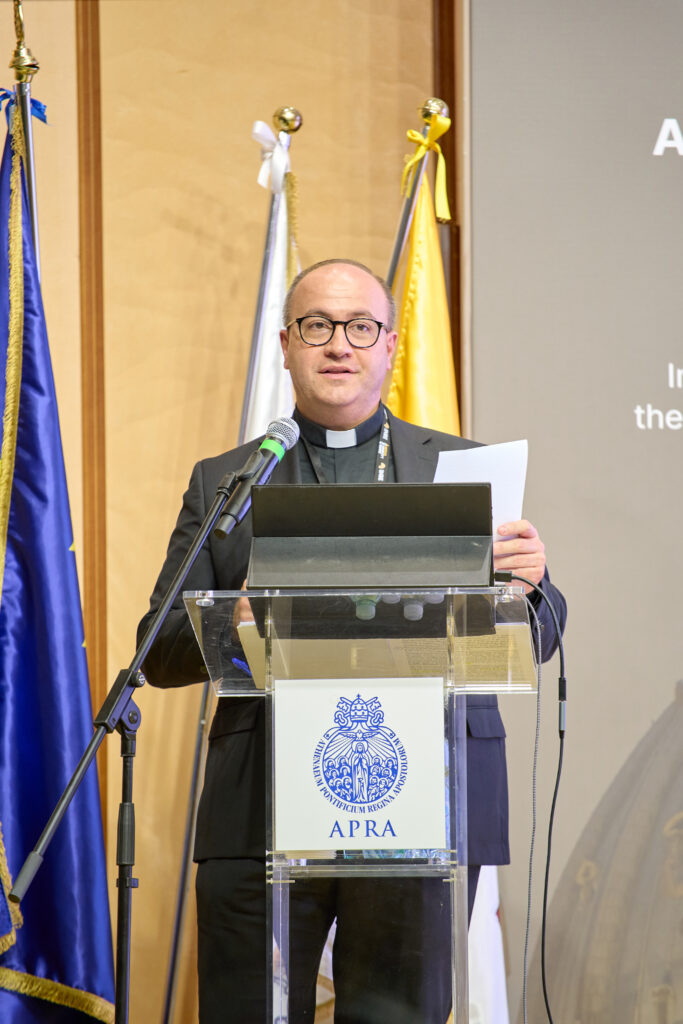
Alberto Carrara, born in 1980, priest of the Congregation of Pontifical Right of the Legionaries of Christ (2013), Academician and Corresponding Member of the Pontifical Academy for Life (since 2017), Chemical-Biological Laboratory Technician (1999), Doctor in Medical Biotechnology at the Faculty of Medicine of the University of Padua (2004; 2007), Doctor in Philosophy (MSc in Philosophical Anthropology, 2011; PhD in Neuroethics and Philosophy of Mind, 2021), Doctor in Theology (BSc, 2013).
At the Pontifical Athenaeum Regina Apostolorum in Rome he holds the following positions: Dean of the Faculty of Philosophy (since January 1, 2024); Coordinator of the GdN, Interdisciplinary Research Group in Neurobioethics; Professor of Philosophical Anthropology and Neuroethics (Faculty of Philosophy), Professor of the Master’s Degree in Science and Faith and the Diploma in Bioethics;Fellow of the UNESCO Chair of Bioethics and Human Rights and Professor and Member of the research group of the ISSD, Institute of Higher Studies of Women. In 2015 he was Professor of Neurolaw at the Faculty of Law and since 2017 he is Professor of Anthropology and Neuroethics at the Faculty of Psychology at the European University of Rome (UER).
In addition, he is a Professor recognized by the M.I.U.R. and Member of the Scientific Council of S.I.S.P.I., International School of Specialization with Imaginative Procedure; Member of the Scientific Committee of the BR Foundation (Brain Research) onlus; Member of several ethics committees, including that of BioRep, s.r.l.; Member of the Society of Neuroethics and SINe, Italian Society of Neuroethics. Since October 2021, he has been President of the International Institute of Neurobioethics (IINBE). Since 2017 he has collaborated with Stephen M. Stahl in the field of neuroethics of seriously ill psychiatric patients, Founding Member of ICONN, International College of Neuroethics and Neuroscience of California and since 2024 Member of IAIED – The International AI in Education Society.