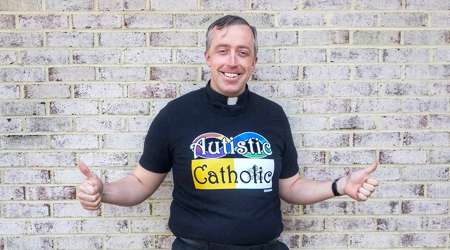
On the occasion of World Autism Awareness Day, Fr. Matthew Schneider, LC decided to make his autism diagnosis public and share the “need to evangelize this segment of the population”.
Through a video (in English) published on his YouTube channel on March 29, Fr. Schneider stated that “we are about 1.5% to 2% of the population. We have a much higher chance of being atheists, a much lower probability of attending religious services weekly… we need someone to reach out to that community, to teach the Gospel to the autistic mind”.
He also said that he decided to share his story with a desire for transparency and hope for evangelization. He pointed out that “we have to bring those people into the community,” suggesting that a Christian understanding of charity should foster this inclusion.
Autistic individuals may have difficulty translating concepts or ideas into human language, while waiting for others to understand the point they are trying to express, said the priest. “But with God in prayer, I can share my ideas directly with God, without translating them into human language,” he assured.
In an interview with CNA — the English-language agency of Grupo ACI — Fr. Schneider spoke about his life at the intersection of autism and Catholic priesthood, and his hope to bring the Catholic faith to more people who share this diagnosis.
“Autism is primarily a distinction in a way of thinking, a neurological difference,” he indicated. Likewise, autism presents challenges, including difficulty in perceiving subtle and non-verbal cues. For the father, this means putting in extra effort when socializing.
The father recounted that upon “realizing that I was going to face these difficulties, I try to give my best, even if it exhausts me.” “I have what is a kind of stereotyped autistic memory, which is a very good memory for details and facts, that has been useful in different ways as a priest,” he assured.
He also discovered that he can overcome some of the challenges associated with autism through a method called Theory of Mind, which involves guessing what another person is thinking while talking to them. It also helps him prepare homilies and write articles, anticipating how his audience might react when reading or listening to his work.
“That is something I do consciously, while most people simply do it unconsciously,” he explained.
However, even with these tools, some tasks would be especially difficult for an autistic priest, said Fr. Schneider. A typical assignment or role in the parish, such as a school chaplain, would pose problems, given the difficulty autistic people often have in perceiving non-verbal cues, especially during face-to-face conversations.
Like many in the autistic community, Fr. Schneider has a sharp memory and a good mind for facts. He tends to be a concrete thinker, writer, and preacher. He describes himself as “intellectually driven” and has always been a good student.
Fr. Matthew Schneider recalled when he was asked to continue as a school chaplain and youth ministry leader. “I didn’t expect it. I knew it was a new role and I had made some mistakes, but I thought, well, there’s a learning curve, and almost anyone will make some mistakes when assigned to a new role like that,” he remembered.
While the experience was frustrating at the time, he now sees it as a blessing, because it eventually led to his autism diagnosis. This helped him better understand himself and, ultimately, find roles in ministries where he was better suited.
“We can present the faith in an emotional way that is good for many people, but autistics tend to think much more logically. So, just a more logical explanation is more helpful… so we understand why,” he said.
On the other hand, he mentioned that his superiors in the Legion of Christ have been very supportive, and that “I wasn’t sure what kind of attitude they would have or what kind of things they would want when I was diagnosed.” However, he assured that he was received with support and encouragement, which manifested in “simple things, like helping me advance toward ministries where I am more likely to succeed as an autistic person”.
“There’s no magic wand, and there’s no moment when I stop being autistic, when I can perfectly understand those social cues. I can strive to understand them better, but it won’t be exactly the same as in the case of non-autistic people,” he expressed.
Fr. Schneider hopes to see catechetical materials and programs developed to better address these characteristics of the autistic mind. He also indicated that people with autism “tend to have a very strong long-term memory, and that can be an advantage for learning about the faith, since we never forget what we are taught, so we don’t need as much repetition”.
He is currently working on a doctoral thesis in Theology, while helping at the retreat center in Maryland where he lives. He said his goal is to become a seminary professor or writer, as “these are fields where, as an autistic, I believe I will succeed more than in many other stereotypical priestly ministries, like parishes or chaplaincies”.
“Jesus loves us, Jesus wants what’s best for us, whatever our situation. This is life, and as autistics, we have the opportunity to experience God’s love in an autistic way. We don’t have to conform our own experience with God, in prayer and liturgy, to how others think, but we can experience it in our own way, which is 100% valid,” he affirmed.
Fr. Schneider had not spoken extensively about his diagnosis outside his community. He has two Twitter accounts: one public with his name and another with the username @AutisticPriest, where he posts about faith and autism. He plans to launch videos on YouTube about topics such as prayer and Christian theology, presented in a way that is more conducive to the autistic mind.
Translated and adapted by Carla Marquina from Aci Prensa. Originally published in CNA.