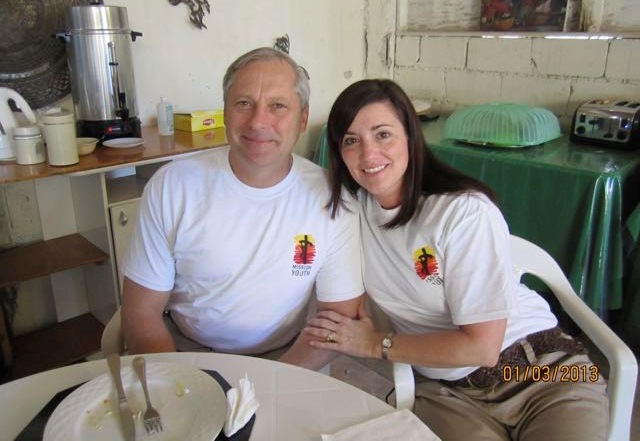
Donna Garrett has been a member of Regnum Christi since 1999. She has been married for 27 years, has 4 adult children, and lives in Omaha, Nebraska. She is a pediatric nurse. She is also a member of the territorial Steering Committee of Regnum Christi in North America and regional director of the Movement in the Heartland area in the United States, which covers four states. In the context of the strategic planning meetings for North America, held in Atlanta from August 17 to 21, she gave an interview which we present below.
Why are you a member of Regnum Christi and how has your membership in the Movement helped you in your personal life?
I am a member of the Movement because God desires this of me. When I first learned about the Movement, I gathered all the information I could, obtained some written materials, and then shared it with my husband. I told him I felt that God was inviting me to commit to Him through this movement, but I thought it was important to know if he would support me in this decision. After a few days, he told me he believed that Regnum Christi was right for me. After about 3 or 4 months, my husband could sense the joy in my faith that God had given me, and shortly after, he also joined the Movement.
God has blessed me greatly. I came into contact with Regnum Christi when my children were small. They belonged to ECYD. Today, I have four young adults, two men and two women, mature and convinced of their faith, who are in college. Some people tell us that my husband and I are excellent parents. Perhaps we have done some things well with God’s help. But it must also be said that all our children have had a healthy circle of friends, and their contact with the Legionaries of Christ and the consecrated members of the Regnum Christi has positively marked them. We have found in ECYD a complement to our formative work and a help in transmitting the faith to our children.
During these meetings and also during the reflection process of 1st and 2nd grade, there has been talk about the mission of Regnum Christi and how we can better fulfill it at this moment in our history. How do you think we can better collaborate in evangelization?
I believe we must have a clear intentionality in everything we do and at the same time be open to the inspirations of the Holy Spirit. Intentionality because our charism leads us to form apostles who collaborate in establishing the Kingdom of Christ, but not in such a way that we close the door to the Holy Spirit, who sometimes guides us along unexpected paths.
I live in a place where there are no communities of Legionaries of Christ or of the consecrated members of the Movement or lay consecrated persons. In the entire region I coordinate, the growth and development of the Movement have been led and carried out by laypeople. We have done this through experiences in small groups (small groups) where spiritual experiences can be had and deep relationships established. We are convinced that the gift we have received as a Movement—to form and send apostles of the Kingdom—would be fully realized only if we found people with whom we could share our testimony and experience. That is why we formed these teams. And when a Legionary or a consecrated member visited the area, we had the opportunity to expose them to another facet of the Movement, so they could have a more complete, fuller vision of what Regnum Christi is and of the fruits of the charism lived and in action.
If the work has been carried out by laypeople, we assume they are the ones holding leadership positions in the Movement in the area. Is that correct?
We have never been able to have a Legionary or a consecrated member as a coordinator of apostolate or as a section director on site. We have had to do it ourselves. Initially, we appointed some laypeople to the role and then trained them. But with the scandal surrounding the founder, it was precisely those with some responsibility who were most affected, and many of them left Regnum Christi. In my region, instead of seeking specific leaders to assume roles in the area, we looked at the people participating in the Movement, their talents, and encouraged them to collaborate more fully in the mission by taking on some task. But after appointing them, we continued walking with them. We know from experience that sometimes the growth of a locality or apostolate is affected because the person in charge may not have been ready for it. This has taught us that accompaniment, which is the principle of person-to-person support, must continue over time because we can never say we are fully formed.
Can the Movement flourish without the consecrated branches?
As a layperson, I am 100% convinced that I have a vocation to Regnum Christi and that through the Movement I have found a path that God has chosen for me to collaborate in the building of the Church and grow in holiness. However, I cannot respond fully to my calling alone: I need the spiritual support of my Legionary brothers, my consecrated sisters, and the testimony they can give me and my people. For Regnum Christi to grow solidly, we need the full participation of the rest of the spiritual family: Legionaries, consecrated men and women.
When we speak of the flourishing of the Movement, I think it is important not to apply a standard measure to all localities. Rather, we should see what the people who make up a locality, a section, an apostolate can give, naturally inviting them to generosity, but with great realism. We also need to consider the differences in resources available: trainers, presence of Legionaries and consecrated members, Movement institutions such as schools, camps, etc. Accompaniment involves understanding the reality of each person or locality and walking with them toward their maturity in Christ.
How do you live your insertion into the local church?
In Omaha, there has never been a separation between Regnum Christi and its service in the local church. I did not have a school, a retreat center, or Legionary communities… so the obvious place for my apostles to serve the church was the parish. We are aware that we are members of the parish and apostles serving the Church there and in the diocese.
When I joined Regnum Christi, my parish was newly established, in a rapidly growing area of Omaha. My pastor was not very enthusiastic about the Legion, but he recognized the need for apostles eager to serve. He admired the tenacity of the men and women of Regnum Christi and, although we sometimes felt some tension, he knew that if he entrusted something to a member of the Movement, from cleaning the church and fixing the benches to organizing the patronal feast or participating in the parish finance committee, it would be done. After the scandal involving the founder, a new pastor was assigned to us who had experience with charismatic renewal and appreciated movements. So, 12 years after my joining, doors began to open in parishes. We also now participate in several diocesan committees by invitation of our bishop. What we do in all this is support diocesan programs and contribute the formation and apostolic heart of the men and women of Regnum Christi.
Has this ecclesial experience enriched your own experience of the Movement in any way?
I have discovered that there are many needs in the Church where members of Regnum Christi can serve with their talents. We cannot limit ourselves to our own programs but must cooperate with others, enriching them with our charism and also receiving the gifts that others bring to ecclesial communion.
We have also learned that all apostolates, no matter how small they may be, must inform their activities to the pastors. It is common practice for us to send a report to the bishop and the parish priest about what we do, as a concrete expression of our desire to be active members of the Church and to live the apostolate in communion.
One of the challenges the Movement faces is leadership formation. What do laypeople need from those who are being prepared in the houses of formation of Legionaries and consecrated members?
I believe we can distinguish a practical aspect and a charismatic one. Analyzing our history, we have not really gotten into big problems as long as we had great confidence in who we are and what we do: forming apostles… With the founder’s actions, we stopped accompanying people on their journey because we were unsure how to do it, what to offer them. Now it is time to revisit and offer these elements renewed through the path we have traveled and continue to walk with the Church. But above all, what a Legionary or a consecrated person can best offer, and that their trainers can transmit, is confidence in our vocation and mission, and the certainty that there is a place in the Church for the gift we have received, for the mission God has entrusted to us.
Secondly, we must always keep in mind the grace of state that the Lord offers us when we accept a mission in the Church, especially if it requires us to broaden our horizons… but it is also true that this extra that the Lord asks of us must consider our human capacity and our nature. We cannot expect anyone to be superhuman because that is not possible. One might be “super-spiritual,” but not superhuman.
Another important point in leader formation is that a leader can be entrusted with a mission even if they are not fully prepared for it, but what cannot be done is to abandon them. They need constant and close attention. I believe that this is where we have sometimes failed: we stop being present, accompanying, and assume that the Holy Spirit will grant the grace and everything will turn out well. These people may be doing well for a few months, but when a major issue arises—like what happened to Regnum Christi or in any family life—such loneliness can have negative repercussions on their spiritual life. Personal attention is essential, as is appropriate discernment.
Anything else you would like to add?
All members of the Movement must be aware of our responsibility before God and the family to safeguard and express our charism and to help each other. If a Legionary comes to work in a diaspora locality, they should expect that the local lay director will do everything possible to help them fulfill their mission. And they will also be expected to commit themselves to the mission. Legionaries and consecrated members should also expect, and even demand, that laypeople live responsibly in their mission and contribution to Regnum Christi. God wants each of us to respond with generous dedication to our vocation. This requires charity and clarity, as well as a strong sense of responsibility in living our mission and our role within our spiritual family.