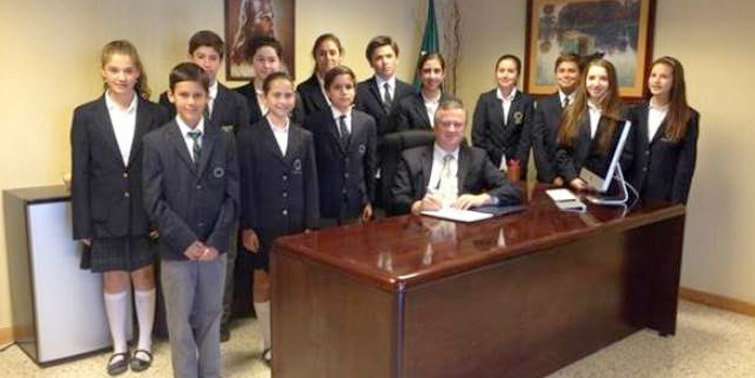
Interview with Kevin Egan on the educational challenge in Regnum Christi schools.
Kevin Egan is a layperson of Irish origin who has worked in educational works of Regnum Christi since 1983. He began working in the educational field in Dublin, the United States, Spain, and Mexico. He was a school director in Saltillo for 8 years, 4 years in Guadalajara, and 4 in Cumbres de Caracas. For the past 4 years, he has been working at Colegio Himalaya in Monterrey. He has given training courses on education and pedagogy to various groups of Legionaries.
What is the history of Colegio Himalaya?
First of all, it should be said that Colegio Himalaya is about to celebrate its 20th anniversary. It is a school that started with a small kindergarten, and later moved to its current location to become a preschool. Then, the different sections gradually opened, thanks to the efforts of the various directors it has had. In reality, it is a school still under construction. Currently, there are 170 staff members, a director of formation, Fr. Alberto Leal, L.C., a chaplain and spiritual advisor, Fr. Patrick McMenamin, L.C., and H. Xavier Gutiérrez, L.C., in charge of formation. We also have the support of Andrea Infantozzi and Lorena Portillo, consecrated women working at the school, and Gloria Fernández, also consecrated, who mainly attends to families, together with Fr. Alberto Leal, L.C.
Why has the student enrollment increased?
We have tried to implement a plan that includes modernization of the educational program, but above all, we have relaunched a classic aspect of the Regnum Christi educational model: ensuring that all students are attended to in every aspect—intellectual, spiritual, human, and social—equally. Sometimes it seems that in Catholic schools we only focus on the spiritual part. When we talk about Integra Mulier and Integer Homo, we must seek to develop all aspects of the person. To guarantee the application of this personalized attention, we have systematized it so that it does not remain just a good intention.
Some priests and Legionary religious go out for ministry or internships in educational works. How is evangelization carried out in a school?
Evangelization is a very broad word and depends on each stage of the students’ formation. In our school, we have a department of Catholic formation and a team specifically dedicated to this aspect, which is crucial in all Regnum Christi schools. Starting from 4th grade, the external part of this formation begins, which involves reaching out to others through social participation. Additionally, it involves involving families in the evangelization of their children: some, for example, not only participate in Holy Week missions but also continue to go as a family each month to some towns to continue evangelizing.
Now, the internal part of evangelization is the most important and naturally includes promoting Eucharistic life, spiritual direction, confession, cultivating love for Mary, and above all, the experiential knowledge of God. Traditions and devotions are helpful, of course, but they are not enough. We must help each member of the school—students, teachers, etc.—to come to know God. I believe many people pass through Catholic schools and learn how they should love God, but without truly knowing who God is. It is very important to teach them the art of talking with Him, the art of knowing Christ, which is a gift. Without knowledge, love cannot exist.
What is expected of a religious arriving from internships at a school?
Undoubtedly, spiritual direction is a very important element of their apostolate. But the religious who arrives at a school must care for and be interested in all aspects of the person, not just the spiritual. This, perhaps in practice, is not always done. But each Legionary should be aware of this to influence the lives of the people. I believe they should approach those responsible for various areas of formation and not work in isolation. Therefore, the religious should occasionally visit classrooms to see how the teacher is teaching, whether they are truly helping the students to reflect, and if there is a problem, report it to the head of studies. The religious should also attend sports events of their students; learn about the social life of the students… Although they may not participate in everything, it is important that they at least stay informed about these aspects to understand the students’ lives and guide them. Due to their closeness to the students, they can help the rest of the management team to fulfill our mission of comprehensive formation effectively.
The art of a Regnum Christi school lies in teaching children how to shape themselves and understand that they are the primary architects of their formation (of course, with the action of the Holy Spirit). This is arduous, demanding, and at the same time, passionate. Any student can pass through our school, and they might do quite well without us realizing what is happening in their lives. Later, they may succeed or fail in university, in their professional life, or in marriage. But that would be tragic. When there is in-depth formation, where the student becomes aware of the why behind everything, the school begins to be a true center of attention and accompaniment, an authentic educational center. The idea is to develop habits for life. Perhaps they will not live the virtues perfectly upon leaving school, but at least they will have had a small experience. My experience is that many young people gladly return to the roots where they were happiest.
How has technology helped in the renewal of the school?
At Himalaya, we have a contract with Apple and have the most advanced technology in the school. We are in the process of official recognition created by Apple. But the key question in this regard is: by introducing this technology, am I helping the child learn how to learn? Technology is a tool with advantages and risks. So far, it has worked very well, and probably more Regnum Christi schools will begin to incorporate these educational tools.
We have talked about family support; how does this work in practice in a school?
It is the principal’s mission, of course. I dedicate time to attending to them. Moreover, families are attended to by the director of formation and Gloria Fernández, not only regarding issues directly related to the school but also concerning the formation of their children and their own married life. The prefects of studies, discipline officers, and area directors are also available to parents and students. I could say that at Himalaya, in a way, parents are over-attended. We are convinced that today’s parents need this. In any matter or concern about their child, parents receive immediate attention. We strive to always keep the door open for everyone.