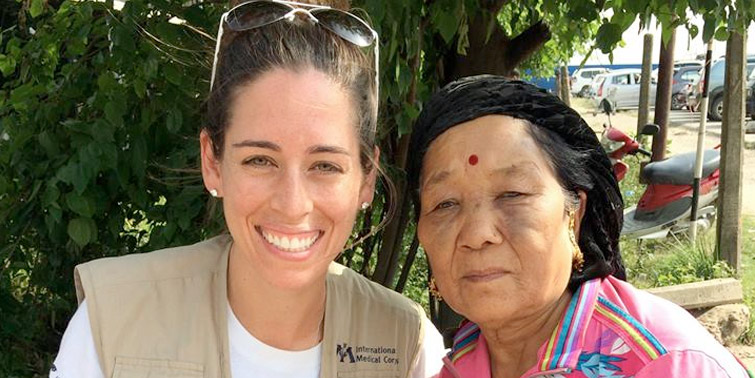
Kelly Suter shares some experiences of the support provided to Nepal during the earthquakes.
Nepal is, without a doubt, one of the most beautiful countries I have seen. A country with a rich culture of generosity, respect, and kindness. I am amazed by the people I can help here in Nepal, as they are people I deeply respect.
I arrived in Nepal about two weeks ago. Shortly after arriving in Kathmandu, I traveled to Dhading Besi, the main district of Dhading which would be my base. The Dhading district is northwest of Kathmandu and is one of the districts most affected by the recent earthquake. The terrain is mountainous and hilly, with dangerous roads that people are reluctant to travel. Through these snow-covered hills and mountains, villages seem to hang by a thread due to the steep landscapes. The houses here are made of stone. Although picturesque, these stone houses did not withstand the magnitude 7.8 earthquake. In many villages, only piled stones remained. Aid arrives very slowly due to the difficult terrain, which was also damaged or simply became impossible to traverse.
My responsibility as the emergency health director of Dhading is to monitor the activity and participation of the mobile medical unit of Dhading. The medical unit is mainly composed of American nurses and doctors, along with local volunteers who serve as translators, secretaries, and medical assistants. For several days, the local district health office of Dhading identifies and assigns the mobile medical unit the village that has not yet received aid after the earthquake. Once the location has been determined and supplies organized, our team travels there by helicopter. We stay for two days providing health clinics, assessing the damage caused by the earthquake, speaking with community leaders to identify needs, and finding patients who require immediate evacuation to be taken to hospitals in the main cities.
The first village I visited with the mobile medical unit was Darka, located north of Dhading Besi. Like many others,
 |
||
|
||
Darka was completely damaged by the earthquake. The health center collapsed, families are living in makeshift shelters that will not withstand the rainy season, water pipes were damaged, and there is crime in the area.
The mobile medical unit treated about 200 patients in Darka. Of these, 3 needed to be evacuated. The first patient was a six-year-old girl who required delicate treatment due to a burn on her arm, as she was already losing sensation and movement in the affected limb. The second and third patients were elderly women who were seriously injured during the earthquake. One had a fractured pelvis, and the other had a broken foot. Despite their fractures, both women continued caring for their families and working in their fields, as their families’ survival depended on them.
The mobile medical team transported the first two patients by helicopter to Dhading Besi while I stayed behind to accompany the other patients in another helicopter to Kathmandu. As our helicopter took off, Lalmaya — one of the elderly women — started crying. Unable to speak her language, all I could do was approach her and hold her hand. She stopped crying but held my hand tightly throughout the flight to Kathmandu. After unloading the patients from the helicopter and transferring them to a vehicle, I took a water bottle from my backpack and offered it to Lalmaya, showing her to drink from it and pass it to the others. She looked at me and slowly shook her head. I thought she was upset about something I had done wrong and was expecting her to start complaining, but she simply placed the water on her lap and began crying, covering her face with her hands. Shortly after, she uncovered her face, took both of my hands with hers, and started kissing them. Then she pulled me closer to place her hands on my face. Although we did not speak the same language, I knew very well what she was trying to tell me when she held my face with her hands. I will never forget her gesture of gratitude.
After taking each patient to the hospital and convincing Lalmaya to let go of my arm so she could go to X-rays and I could leave, I finally reached the vehicle and returned to Dhading Besi. The following days were free days for the mobile unit, but it was May 12. Being in Nepal in the days after the earthquake accustomed us to daily stress, and we were hardly aware of it. But when the second earthquake shook Nepal and the ground started trembling that afternoon, growing in intensity with each moment, we became aware of the event. A team member started shouting for everyone to exit the building. Once outside, we stopped to regroup and saw how the next building swayed from side to side. We joined the rest of the people in Dhading, running and shouting through the streets until we moved away from the buildings to an open field. Then we waited.
After a while, we returned but had to run again due to another tremor. All of Dhading Besi was in chaos, with people packing to go to the hills, preferring the danger of the road over being crushed by buildings. After the third tremor, we also decided to leave the building. We moved to a goat field. At 3 a.m., a magnitude 6.1 earthquake struck Nepal, waking us violently. One thing is experiencing an earthquake standing up, and quite another is lying down and sleeping when suddenly you hear the ground cracking violently and feel the tremor — it disorients and frightens you.
Before the second earthquake, we ignored the sounds of the few aftershocks, but now the creak of a door, the noise and vibration of a truck on the street, and even the feeling of losing balance caused us a shock that left us frozen. We all carry an emergency backpack with our passports, and we sleep with something that allows us to get up quickly and run through the streets. Ultimately, we have a better understanding and deep respect for what the people of Nepal have been experiencing.
From the outside, aid may seem heroic, but from within, everything looks very different. It is a privilege and a gift to be the person here to bring hope and help heal suffering. While it can cause fatigue and physical pain, at the same time, it fills me with life, energy, and a greater purpose.
****
Article translated from the original in English “Kelly Suter: first report from Nepal” on http://live.regnumchristi.org/.