By Karl-Olaf Bergmann
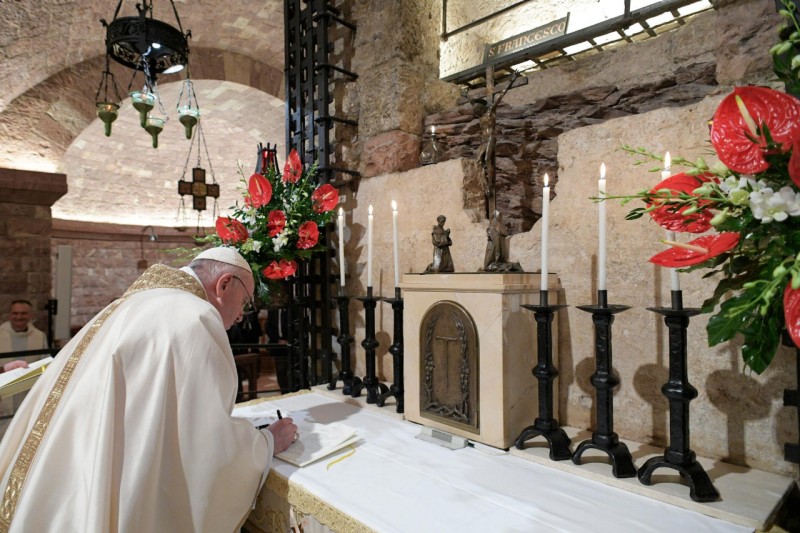
“Fratelli tutti,” Saint Francis of Assisi wrote to address all brothers and sisters and to propose a way of life with a taste of the Gospel.” This is how Pope Francis’s new encyclical begins. It is about brotherhood and social friendship in today’s world. The Pope signed the encyclical on October 3, 2020, in Assisi.
The focus of the encyclical is presented as the “teaching on brotherly love” in its “universal dimension,” that is, in its openness to all people (cf. n. 6). “Fratelli tutti” follows the tradition of papal social encyclicals. Pope Francis sketches a dream of brotherhood and social friendship for all humanity:
“Let us dream of a single humanity, as travelers of the same human flesh, as children of this same earth that shelters us all, each with the richness of their faith or convictions, each with their own voice, all brothers.”
In the (the first chapter), he addresses issues and limits of the market economy, as well as the concerns and needs of the elderly who have to suffer especially from the consequences of the coronavirus, and the global refugee problem. He describes these and other connections against the backdrop of human history, its developments and setbacks, our culture, and our current way of life.
Where can the world and the human family find strength and hope again? What offers guidance and support? What are the foundations of peace, solidarity, and progress? In the second chapter, the Pope begins with a comprehensive biblical interpretation and contextualization of the parable of the Good Samaritan (Lk 10:25-37) — “a story that repeats itself,” as he says.
In the third chapter, the Holy Father creates perspectives to be able to “think and create an open world.” “A human being is made in such a way that they do not realize, do not develop, nor can they find their fullness ‘unless in sincere self-giving to others,’” writes Pope Francis. The Christian understanding of love acquires a universal dimension and is introduced for the first time into completely new contexts: at the level of cities and countries, the global world, politics, and economics. In a way, Pope Francis’s vision appears here as a direct counterattack to prevailing ways of thinking and geostrategies.
The Pope deepens these ideas in chapters four to seven (Chapter four: “A heart open to the whole world”; chapter five: “The best politics”; chapter six: “Dialogue and social friendship”; chapter seven: “Paths of encounters”), and in the eighth and final chapter he revisits the special role of religion “in service of fraternity in the world.” With this, his new encyclical also acquires a highly universal-ecumenical significance, an aspect that in recent years must appear more than justified in the context of religiously motivated terrorism.
“It must be acknowledged that ‘among the most important causes of the crisis of the modern world are a numbed human conscience and a distancing from religious values, as well as the dominance of individualism and materialist philosophies that deify man and place worldly and material values in place of the highest and transcendent principles,’” writes Pope Francis in the final chapter, making clear that, from his point of view, the issues of God and truth are central to this universal vision of love, solidarity, and fraternity that he wishes to invite and encourage all humanity to embrace. For the Church, ultimately, this also means that, on the one hand, it respects the autonomy of politics, but on the other: “It does not relegate its own mission to the realm of the private.”
The encyclical concludes with a comprehensive call from Pope Francis for peace, justice, and brotherhood, and a prayer to the Creator.
With nearly 300 footnotes, the encyclical also attests to a profound engagement with previous pronouncements of the Holy See and the breadth of its own reflection bases.
The Pope’s encyclical can be read here.
————–
Karl-Olaf Bergmann is the Director of Communications for Regnum Christi for the territory of Central and Western Europe.