“No one has greater love than the one who lays down his life for his friends” (John 15:13)
“Go be a collaborator!” “Go be a collaborator!” was repeatedly echoing in my mind on a Tuesday night in July. I couldn’t believe it! Throughout my life in the Kingdom, I had grown convinced that being a collaborator was just an escape to avoid commitment in your own section, I didn’t disapprove but I was sure I wouldn’t be a collaborator. However, this “restlessness” was so clear and insightful that in less than a week I had reversed all my plans; I was starting my year as a collaborator; and with it, the first step towards the most unexpected of my lives.
I am the second of three children in a “normal” Catholic family, of those who, like everything, have wheat and tares. I studied at a religious school that, from a young age, introduced me to the life of faith and apostolate. I also received good teachings about this in my family; my paternal grandmother, for example, dedicated all she could to serve others: she took me to activities to maintain an old people’s home and she took the initiative to help the poor generously; she always taught us to value religious, priests, and seminarians very much, whom it was not uncommon to see at home; she earnestly emphasized the importance of prayer and never tired of telling me that “without God we can do nothing.” It was in this context that, around the age of five, I was sure I would become a priest.
By the time I was twenty-three, when I began my year as a collaborator, the tares had already gained significant ground, as a consequence of my bad decisions influenced by social inertia, the pains I encountered along the way and their wrong solutions, my own imprudences—which are very characteristic of me—and so on. Let’s say that “coherence” and “virtue” were not the most appropriate words to describe my life.
However, the wheat was not extinguished either; for example, at the start of university, which is when I met the Legionaries of Christ, “the fathers” invited me to missions or looked for me to “talk,” I successfully evaded them on several occasions, but behind it was “Someone else” who would not give up. Little by little, providentially, I got involved and committed to the apostolates: I went on missions and took orphaned children from missions, visited hospitals for children with cancer, organized large events for poor children, etc. It was an opportunity to experience firsthand the paradox that “the one who gives more, receives more; the one who loses his life, gains it” (cf. Mark 8:35; Matthew 16:25). It was here that I also received the blessing of my friends from the Kingdom, which I increasingly value over time. We couldn’t help but say “how good it is to be here.”
When I arrived at the cursillo of collaborators, with more than a hundred young people who generously would give a year of our lives to Christ, I felt perfectly out of place. I had to make a deal with the Lord: if He wanted it, He had to take care of it, because I couldn’t. It worked quite well! It was a time of special graces that has extended from then on. It was like the first step of the prodigal son, on the way back home, longing for the Father’s house, and who—without knowing it—will first encounter a great embrace.
With another collaborator, we were assigned two cities, neither of which had a community of priests; in one of them, there had never been collaborators, and in the other, it had been several years without them; it was quite an experience. The new perspective on life made me rediscover everything, as if I had been born again; surely, the One who makes all things new, had something to do with this.
During that year, one morning I meditated on that fig tree from the Gospel, which Jesus approaches when He feels hungry, shortly before His Passion. I thought that surely that was a visible fig tree, with leaves, but without fruit; just like me! I realized I had led a life focused mainly on appearances, the Lord had given me qualities and I used them to boast, but they were only appearances; leaves without fruit. The experience of living to serve others was strengthened. At the same time, I remembered the conviction about the priesthood I professed eighteen years earlier, a fruit of the close companionship with the Lord.
Of course, I tried to run away; priesthood was something too sublime for me—and I didn’t even desire it—so I gladly left it to better people. But this time, without unexpected voices, the certainty that giving my life to God was what followed, developed simply, smoothly, and convincingly. I only communicated it to the minimum necessary. How much it hurt my family! But they never stopped supporting me, and little by little, it became clear that the vocation was a family matter.
The next step was “the candidacy”: a first trial period to discern the vocation. I enjoyed it so much that I started to believe that all my friends from the Kingdom should do it. I wondered how someone who crossed paths with God could not freely consider what God wants from him… Still, I hoped—with desire—that the priests wouldn’t let me enter the Legion; until my moment of decision arrived, and I simply said “yes”—for life (as long as He sustains me).
The beginning of my Legionary life seemed from another world… and it was. The novitiate was like a whirlwind of charity, proceeding from God, from men, and even from me! In fact, if I had to summarize what it has been, from the very first moment, I would say “a school of charity.” I never imagined I could love so much as to be willing to give my life for someone else, for their well-being (I never imagined that God’s love was so deep and unfathomable, revealing itself day by day). There is no doubt that “no one has greater love than the one who lays down his life for his friends” (John 15:13). I hope we become docile so that God grants us the grace to understand the “size of love” of that Friend who gave everything for you and me.
As in natural life, in religious life one must also mature, and justly I must say that, without losing its wonderful character, not everything has been honey on the hooves. It helps me to think of it as a tree that, to grow more, must be taken out of the greenhouse; or before, the seed that, to germinate, must pass through the furrow; or gold through the crucible… or the Christian through the cross of his Lord. However, it has been precisely in these moments that I have experienced that God is faithful, a faithful Father—and merciful—a rock of my hope.
This is how I approach today’s ordination. Like a work shaped by the hands of the divine artist, but in very humble material. I owe much to those who have been instruments of love in my life. I ask for your prayers to be docile to the grace of the Lord and to carry in the least unworthy way the gift of His holy priesthood.
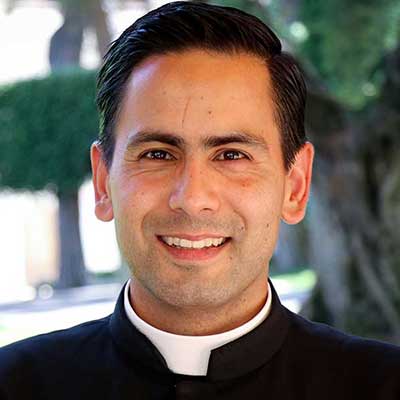
Manuel Díez, L.C. Was born on February 22, 1984, in Tlapacoyan, Veracruz. He studied Law at the Universidad Anáhuac de Xalapa, where he worked for three years. He collaborated in the youth section of Xalapa and joined Regnum Christi in 2005. In 2007, he was a collaborator in Tabasco and Chiapas, Mexico. He entered the Legion of Christ in 2008. He did his Novitiate in Dublin, Ireland, where he made his first religious profession in 2010. He studied classical humanities in Cheshire, Ct., and in 2011 began his bachelor’s in philosophy at the Pontifical Athenaeum Regina Apostolorum in Rome. In 2013, he began his apostolic practices as a formation instructor at the Oxford Institute and collaborated in CREL South and the Timón Club in southern Mexico City. In 2015, he returned to Rome to study Theology and to serve as an auxiliary member of the general administration; where he continues as part of his first ministry.