Pope Francis has granted a plenary indulgence in the form of a jubilee to all members of the Regnum Christi Movement during the year commemorating the 75th anniversary of its founding. This jubilee will conclude on the Solemnity of the Sacred Heart in 2016.
This was announced by Father Eduardo Robles-Gil, LC, through a letter addressed to the members of the Movement, in which he states that the Apostolic Penitentiary of the Holy See has issued a decree signed by the Major Penitentiary, Cardinal Mauro Piacenza, responding to the request of the general director of Regnum Christi and the Legion of Christ, Father Eduardo Robles-Gil, LC.
The jubilee indulgence can be obtained on the solemnity of Christ the King in 2015 and on the solemnity of the Sacred Heart in 2016 if they renew their commitments to the Movement or the Legion out of devotion, and pray for the fidelity of their homeland, for their Christian vocation, for vocations to the priesthood and religious life, and for the defense of the family.
Likewise, a plenary indulgence is granted when they dedicate a suitable amount of time to practicing works of corporal or spiritual mercy, concluding with the Lord’s Prayer, the Symbol of Faith, and the invocation to Mary, Queen of the Apostles.
They are also granted a plenary indulgence when they dedicate a suitable amount of time to teaching or learning Christian doctrine or participate in evangelization missions.
Members of the Legion of Christ impeded by old age or illness may also earn the indulgence by spiritually uniting themselves with the jubilee celebrations and offering their sufferings and prayers for the new evangelization and the establishment of Christ’s Kingdom.
Below is the decree in Spanish. The original in Latin can be accessed from this link.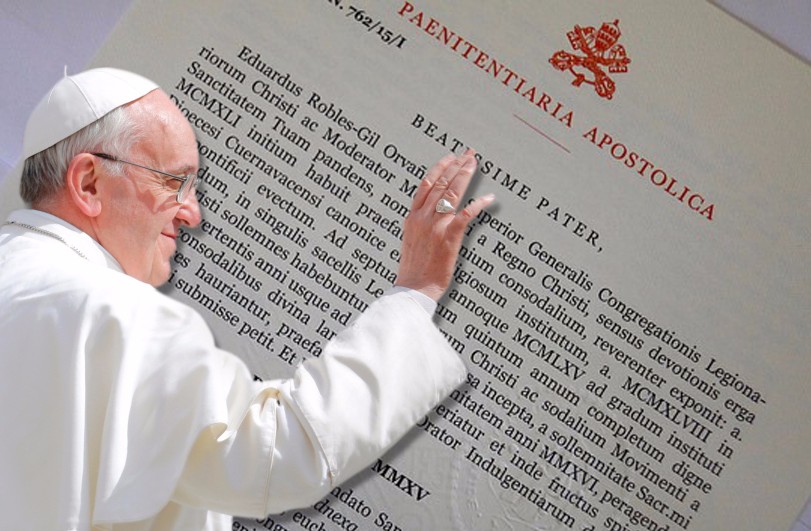
Translation of the original in Latin
APOSTOLIC PENITENTIARY
Prot. N. 762/15/I
B E A T I S I M O P A D R E ,
Father Eduardo Robles-Gil Orvañanos, superior general of the Congregation of the Legionaries of Christ and Moderator of the Regnum Christi Movement, with feelings of devotion to His Holiness and in the name of all members, confidently reports that in 1941 the mentioned religious institute was established, canonically erected in 1948 in the Diocese of Cuernavaca, and elevated to the status of a pontifical institute in 1965. To properly celebrate the 75th anniversary, from the Solemnity of the Sacred Heart in 2015 until the same Solemnity in 2016, special sacred functions and spiritual initiatives will be held in the churches and chapels of the Legionaries of Christ and the Regnum Christi Movement. And so that the treasure of divine grace may be more abundantly applied to the members [of the Legion of Christ and all of Regnum Christi], the aforementioned Orator implores the gift of Indulgence in the form of a Jubilee.
Therefore,
On July 27, 2015
The APOSTOLIC PENITENTIARY, by mandate of the Most Holy Father Francis, graciously grants the Holy Year with the attached Plenary Indulgence, which, under the usual conditions (sacramental confession, Eucharistic communion, and prayer for the intentions of the Supreme Pontiff), members of the Congregation of the Legionaries of Christ and all members of the Regnum Christi Movement, who, with a spirit of penance and united in the spiritual aims of the Year of Consecrated Life and the upcoming Holy Year of Mercy, may earn it once per day and also apply it as a suffrage for the faithful departed in Purgatory:
a.- on the solemnities of Our Lord Jesus Christ, King of the Universe in 2015 and of the Sacred Heart of Jesus in 2016, if they make or renew, even privately, the promise to faithfully fulfill the demands of their vocation and, for an appropriate period, pray to God for the fidelity of their own homeland to their Christian vocation, for vocations to the priesthood and religious life, and for the defense of the institution of the human family, concluding with the Lord’s Prayer, the Symbol of Faith, and the invocation to Mary, Queen of the Apostles.
b.- Whenever they dedicate a suitable amount of time to practicing the works of corporal mercy (feeding the hungry, giving drink to the thirsty, sheltering the pilgrim, clothing the naked, visiting the sick, redeeming captives, burying the dead) or spiritual mercy (correcting the sinner, teaching the ignorant, giving counsel to those who need it, comforting the sad, patiently suffering others’ faults, forgiving offenses, praying for all), concluding with the Our Father, the Symbol of Faith, and the invocation to Mary, Queen of the Apostles.
c.- Whenever, with a trusting heart in mercy, they dedicate a suitable amount of time to teaching or learning Christian doctrine, or to missions for the new evangelization, concluding with the Our Father, the Symbol of Faith, and the invocation to Mary, Queen of the Apostles.
The Legionaries of Christ and all members of the Regnum Christi Movement who are legitimately impeded by old age or serious illness may also obtain the plenary indulgence in the place where their impediment keeps them, if, having detested all sin and with the intention of fulfilling, as soon as possible, the three usual conditions, they spiritually unite themselves with the jubilee celebrations or other spiritual initiatives, offering their prayers and sufferings to God through Mary for the new evangelization of the peoples and the establishment of Christ’s Kingdom.
And so that access to divine forgiveness through the keys of the Church may be easier through pastoral charity, this Penitentiary earnestly requests the Legionary priests and other [priests] members of the Regnum Christi to offer themselves diligently and generously for the celebration of the Sacrament of Penance and to frequently administer Holy Communion to the sick.
This provision will be valid during the Holy Year. Nothing to the contrary.
Mauro Card. Piacenza
Major Penitentiary
Cristóforo Nykel
Regent
*****
|
Doctrine of Indulgences in the Catechism of the Catholic Church (nn. 1471-1479) |
|
1471 The doctrine and practice of indulgences in the Church are closely linked to the effects of the Sacrament of Penance. What are indulgences “An indulgence is the remission before God of the temporal punishment due to sins, which have been forgiven in terms of guilt, that a faithful person who is disposed and fulfills certain conditions obtains through the mediation of the Church, which, as the administrator of redemption, distributes and applies with authority the treasury of the satisfactions of Christ and the saints” (Pope Paul VI, Apostolic Constitution *Indulgentiarum Doctrina*, norms 1). “An indulgence is partial or plenary depending on whether it frees from the temporal punishment due for sins in part or in full” (Indulgentiarum Doctrina, norms 2). “Any faithful person can earn indulgences for themselves or apply them as a suffrage for the dead, whether partial or plenary” (CIC can. 994). The punishments of sin 1472 To understand this doctrine and practice of the Church, it is necessary to remember that sin has a double consequence. Mortal sin deprives us of communion with God and thus makes us incapable of eternal life, whose deprivation is called the “eternal punishment” of sin. On the other hand, every sin, even venial, involves disordered attachment to creatures that must be purified, either here below or after death, in the state called Purgatory. This purification frees from what is called the “temporal punishment” of sin. These two punishments should not be conceived as a kind of vengeance inflicted by God from outside, but as something that springs from the very nature of sin. A conversion that proceeds from fervent charity can lead to the complete purification of the sinner, so that no punishment would remain (cf. Council of Trent: DS 1712-13; 1820). 1473 The forgiveness of sin and the restoration of communion with God involve the remission of the eternal punishments of sin. But the temporal punishments of sin remain. The Christian must strive, patiently enduring sufferings and trials of all kinds, and, when the day comes, facing death serenely, accepting these temporal punishments of sin as a grace; they must apply themselves, both through works of mercy and charity, and through prayer and various penitential practices, to strip themselves completely of the “old man” and to clothe themselves with the “new man” (cf. Eph 4:24). In the communion of saints 1474 The Christian who wishes to purify himself of his sin and sanctify himself with the help of God’s grace is not alone. “The life of each of God’s children is linked in an admirable way, in Christ and through Christ, with the life of all other Christian brothers, in the supernatural unity of the Mystical Body of Christ, as in a mystical person” (Pope Paul VI, Apostolic Constitution *Indulgentiarum Doctrina*, 5). 1475 In the communion of saints, therefore, “there exists among the faithful, both among those who are already blessed and among those who are expiating in purgatory or still peregrinating on earth, a constant bond of love and an abundant exchange of all goods” (ibid). In this admirable exchange, the holiness of one benefits the others, beyond the damage that one’s sin may have caused to others. Thus, the resort to the communion of saints allows the contrite sinner to be purified before and more effectively from the punishments of sin. 1476 These spiritual goods of the communion of saints, also called the treasure of the Church, “are not the sum of goods, as are material riches accumulated over the centuries, but the infinite and inexhaustible value that the satisfactions and merits of Christ our Lord have before God, offered so that humanity might be freed from sin and attain communion with the Father. Only in Christ, our Redeemer, are the satisfactions and merits of His redemption found in abundance” (Indulgentiarum Doctrina, 5). 1477 “Likewise belonging to this treasure are the truly immense, inconceivable, and ever-new price that the prayers and good works of the Blessed Virgin Mary and all the saints, who sanctified themselves by the grace of Christ, following His steps, and performed works pleasing to the Father, have before God, so that, working for their own salvation, they also cooperated in the salvation of their brothers in the unity of the Mystical Body” (Indulgentiarum Doctrina, 5). The indulgence of God is obtained through the Church 1478 Indulgences are obtained through the Church, which, by virtue of the power to bind and loose conferred upon it by Christ Jesus, intervenes in favor of a Christian and opens to him the treasury of the merits of Christ and the saints to obtain from the Father of mercy the remission of the temporal punishments due for his sins. For this reason, the Church does not merely wish to assist this Christian but also to encourage him to perform acts of piety, penance, and charity (cf. Indulgentiarum Doctrina, 8; Council of Trent: DS 1835). 1479 Since the faithful departed in purification are also members of the same communion of saints, we can help them, among other ways, by obtaining indulgences for them, so that they may be freed from the temporal punishments due for their sins. |