By Juan Carlos Arias, LC
Have you ever had your heart stolen? Have you lost control of your life? There are people who enter the heart without asking permission: the friend, the wife, the boyfriend… or even God. Everything changes at that moment—thoughts, attitudes, words. The heart is the center of the person, what drives everything else, what gives life. Losing control of it makes alarms go off.
We always use mothers as an example of love, and it’s true—they are to blame, they love in an exaggerated way, extremely radical. For example, when your mother hears someone speaking badly of you, brace yourself… because you are at the center of her heart, you are what moves her life, in a way, her “life”. What is in the heart of Christ?
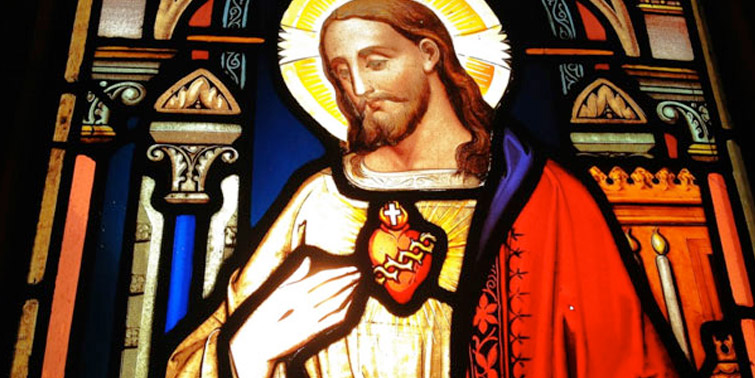
A heart in flames, open, with a cross and a crown of thorns—can it be the heart of God? Yes, the heart of Christ burns, suffers, and gives itself. Throughout history, great figures have left something for humanity: a life example, wise advice, their thoughts and discoveries… Christ leaves us the most intimate part of Himself: His heart. Do we deserve it? No. Just as we don’t deserve true friendship. It’s a gift, a way of loving—giving without expecting anything in return, simply caring more for the other than for oneself.
Sometimes we find it hard to accept the things of God, for a very simple and silly reason—that the things of God are free. Yes, it might be too good to be true, but that’s how it is. Some of us are used to seeing gifts with a certain ambiguity: yes, of course, you give me chocolates because you’re going to ask for the exam summary (that doesn’t happen to me, well… I am the one who gives chocolates), or because the truth is the gift isn’t as good as it seems, or simply out of pride—“I have to earn it myself”. Remember something essential… the one who gives us the gift is God! I believe He doesn’t need much from us, almost nothing. All He wants is to put a little smile on your face—that’s what He needs. Christ wants to give us His heart.
I wanted to reflect on the symbols that surround the images of the Sacred Heart: Heart, fire, wound, cross, and crown of thorns.
The heart is the center of everything; without it, nothing else exists. Sometimes, there is the temptation to overly solemnize God, to place Him so high that He becomes unreachable. In Rome, we have the opportunity to visit many Vatican museums. The art gallery contains paintings from the Gothic period onward. It’s interesting to see the change in art—the colors, figures, depth, symmetry… In the earliest paintings, characters appear static, identical. The background is gold. Everything is very glorious, very solemn, but honestly a bit cold and very similar. Over the centuries, artworks begin to “come alive”. The characters are more realistic, there’s more movement, the artist presents a scene from real life, and we can almost transport ourselves to that moment. God does not want to be that supreme being who is in a distant, unreachable place. I believe that overly solemnizing Him doesn’t suit God. On the contrary, He wants to get into your life, to steal your heart—and He does so in the most loving way, without forcing, by giving us His heart in His reality and humanity. It’s true that as we get to know God more and more, we realize the infinite distance between Him and us. A distance we will never be able to cross, but God can. He demonstrates this in many ways, one of which is with His Sacred Heart.
The flames in the heart of Christ. Recently, I had the grace to be at the Corpus Christi Mass with Pope Francis. The mass was celebrated outside one of the papal basilicas in Rome, St. John Lateran. Halfway through the celebration, the sirens of the fire trucks sounded—a loud and very annoying noise but necessary to go and extinguish the flames burning somewhere in Rome. After the fire truck passed, I reflected that they had mistaken the fire… on the altar, a fire was burning that not all the thousands of liters of water in the ocean could extinguish. The divine ardor is of an unknown intensity. The fire in the heart is very often related to passion for something. It’s almost an obsession with what ignites the heart. The Heart of Jesus burns for each of us, personally.
The flames in my heart. What ignites your heart? What is the obsession of your heart? That which, if it ceased to exist, your life would lose meaning. That which keeps you awake at night. That which, just thinking about it, makes the flames of the heart take flight. Usually, the passion is directed toward something outside of you. The problem is that what you are passionate about begins to control your life in some way, starts to polarize it. What is at the center of your heart—that becomes your god. Is it difficult to relate to God? Could it be because our hearts are full of other gods that are not the true God? Let’s approach the heart of Christ and let ourselves be burned—our hearts too.
The Wound. One of the dreams of every man is to find a bank with the safe door open, the guards asleep, and millions of dollars waiting… Well, the heart of Christ has more riches than all the banks in the world combined. Moreover, His safe is open because of the wound of the lance. Jesus’ riches cannot be measured, sold, or bargained for. True riches lie in intimacy with Him. Christ opens the doors of His heart and invites us to enter into relationship with HIM.
In the depths of the heart is where I am most myself; there are no lies, no masks. What else is intimacy but being oneself in front of the other? That’s what Jesus expresses with His wound—He wants you to know Him and simply be yourself in front of Him, without masks, just you. He doesn’t ask for long prayers or sacrifices; He wants your heart as it is—fragile, small, sinful… HE WANTS YOU!
The cross. Just as man dug a hole in the earth to elevate the cross, so sin made a hole in man’s heart where a cross must also be raised. All human beings suffer; no one escapes pain. It’s hard to understand the cross, but it’s even harder to escape from it.
Christ, who had no hole in His heart because He was sinless, wanted to enthrone the cross in His heart. He did so for a very simple reason: He wants to accompany us in moments of pain. With Christ, every cross is worth it; with Christ, every cross is bearable. With Christ, giving your life is worth it!
Crown of Thorns. If you don’t know how to suffer for someone, you don’t know how to love them. The crown of thorns speaks of fidelity, the fidelity of God’s love. God knew how to suffer for us, knew how to love without diminishing the intensity. True love is synonymous with fidelity: sincerity in a yes, in an I love you just as you are, and wanting the best for you. A fidelity that leads to saying: you are important to me, I love you more than my life, I am not indifferent to your matters. In today’s world, it’s difficult to be faithful because of the distrust among us. But love invites us to risk for the other, and fidelity is fulfilling that risk. God is faithful even if we have been, are, and will be unfaithful to Him.
Something I have learned on this path to priesthood is that a “yes” to God’s call is not enough. You have to say “yes” again and again… “Yes” in moments of consolation, “yes” in moments of cross, “yes” in moments of temptation (just to clarify, it’s “yes” to God, not to temptation), and especially a humble and repentant “yes” after saying “no”. Difficulties in life and falls are inevitable, but we must be sure that the fidelity of God’s love for us will never fail. The oxygen of this earth will run out before His fidelity does. May the crown of thorns remind us that fidelity is a struggle—and that it assures us that He is always faithful.
To conclude, just one phrase: let yourself be robbed of your heart by God!