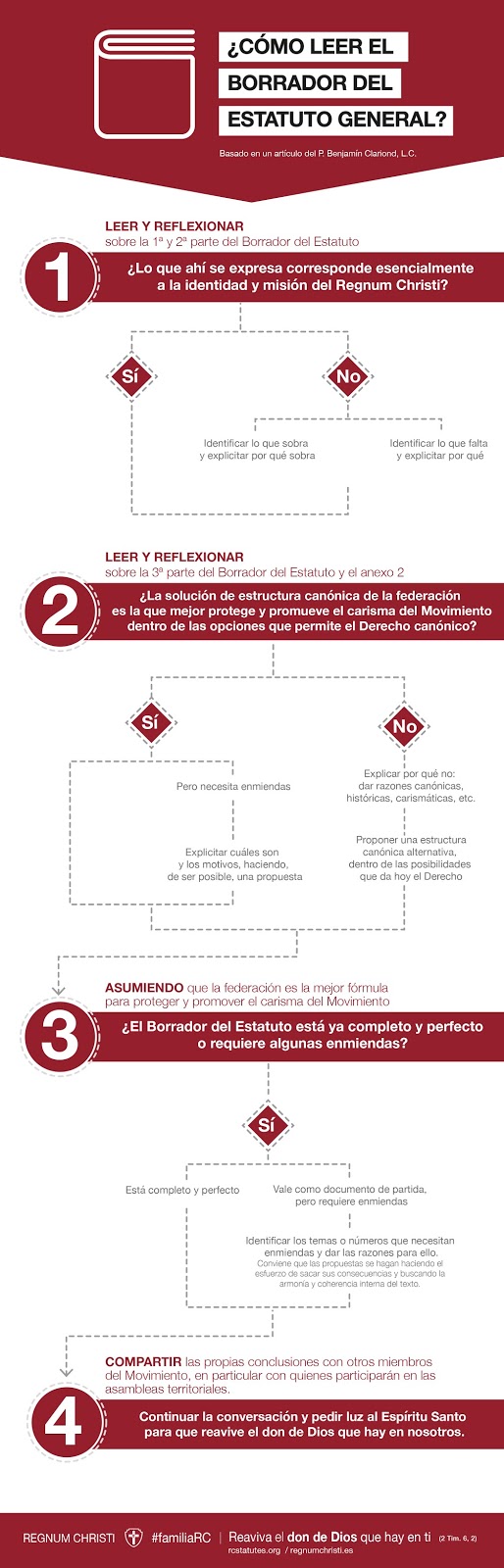
Fr. Benjamin Clariond, LC, has written the following article offering some recommendations to better benefit from personal and team reading and reflection on the Draft of the General Statutes of Regnum Christi, along with a four-step method that helps to make contributions. At the end, you will find an infographic that visually summarizes the process.
On May 23, members of Regnum Christi received the Draft of the General Statutes of the Regnum Christi Movement. It is the result of a process of prayer, discernment, study, analysis, dialogue, and confrontation that has lasted years. And now we find ourselves at a moment where we are called to study it and give our opinion. But, upon seeing the text and its annexes, a question arises… Where do I start?
With this writing, I want to offer some recommendations to better benefit from personal and team reading and reflection on the Draft of the Statutes. I also provide a guide that can help prepare the territorial assemblies that will take place in a few months. This guide was prepared by a legionary from my community in Rome. I have taken the liberty of making some adaptations and sharing it.
Some Recommendations
Before starting the reading and study of the text, it is helpful to keep in mind two things: the process that has been followed for its development and the nature of the document.
The Draft takes as its starting point the Statute of Regnum Christi approved by the Holy See in 2004. It also includes contributions from the legionaries, consecrated persons, and lay consecrated persons during the process of reviewing the Constitutions and drafting the statutes of the consecrated branches. It also considers what has been said by the General Chapter of the Legion and the General Assemblies of the consecrated laity and vowed members. Additionally, it takes into account the process of lay members, initiated in October 2014 and concluded with their international convention in June 2016. It has been inspired by the most recent papal magisterium on movements…
In short, it is a document prepared by a team and endorsed by the General Steering Committee, but in its drafting, all members of the Movement have had the opportunity to participate in one way or another. Now we have another opportunity to do so in the preparation of the territorial assemblies and in the general assembly that will present it to the Holy See for approval.
Regarding the nature of the text, it is a Statute, that is, a legal document that helps safeguard the vocation and identity of the Movement. The first thing a movement’s statute must do is to explicitly state its nature, purpose, spirit, and character, as well as its healthy traditions. This, the Code of Canon Law calls “heritage”, which is the word used instead of “charism”, a term that can have many meanings. A statute must also establish rules about the governance and administration of the Movement, the discipline of its members, their incorporation, and formation. It must harmonize spiritual and legal elements, but without multiplying rules unnecessarily. Therefore, it is a key document for the life of the Movement, but it should not go into too much detail because it must be sufficiently open to be applicable across different countries and cultures and to endure over time. More in-depth reading of this can be done through canon laws 578 and 587 of the Code of Canon Law.
Having this clear, it can be very helpful to approach the text bearing in mind that each of us has some prior preferences and interpretative keys. On Sunday, when we discussed the draft in my community, one who is an administrator was interested in sustainability; another in the governance of the Movement to keep it agile; another in the family spirituality of laypeople; one more in the collaboration among branches at the local level… All of this is correct and good. But it helps to listen to each other to identify blind spots we might have…
Additionally, it is advisable to read the Draft with the desire to understand what is being proposed and the values that are sought to be safeguarded. The annexes can help. But, once again, dialogue with others, including those from different branches and vocations, can be very illuminating. If I don’t understand: ask, study, consult.
It is also helpful to keep in mind that the development of the Statute is not a political exercise, but an exercise of listening to the Holy Spirit who also speaks through our brothers and through history. We want to better understand the gift of God that is Regnum Christi, to deepen it, and to create the conditions for it to respond to God, flourish, and bear fruit.
A Guide for Reading
Getting into more practical elements, the Draft can be read following four steps.
1st step: Read and reflect on the 1st and 2nd parts of the Draft of the Statutes (chapters 1 to 7), which mainly describe the heritage or charism of the Movement: nature, members, general lines of spirituality and apostolic action, etc. During the reading, ask yourself if what is expressed there essentially (not exhaustively) corresponds to the identity and mission of Regnum Christi.
- If the answer is “Yes”: Proceed to the 2nd step.
- If the answer is “No”:
– Identify what is superfluous and explain why.
– Identify what is missing and explain it, justifying this lack, preferably using the 2004 Statutes or other official texts of Regnum Christi.
2nd step: Read and reflect on the 3rd part of the Draft of the Statutes (Chapters 8 to 12) and Annex 2 (which explains the possible canonical figures and why a federation was chosen). During the reading, ask yourself if the canonical structure solution of the federation, as described in the Draft, is the best way to protect and promote the charism of the Movement (analyzed in the 1st step) within the options allowed by Canon Law.
- If the answer is “Yes”: Proceed to the 3rd step.
- If the answer is “Yes, but it needs amendments”: specify which ones and why, making, if possible, a proposal.
- If the answer is “No”:
– Explain why not: give canonical, historical, charismatic reasons, etc.
– Propose an alternative canonical structure, within the possibilities offered today by Law (e.g., third order, association of the faithful, etc.)
3rd step: Assuming that federation is the best way to protect and promote the charism of the Movement, both for the entire Regnum Christi and for each branch, ask yourself if the Draft of the Statutes is already complete and perfect or if it requires some amendments (changes, deletion of numbers, edits, additions, etc.)
- If the answer is “Yes, it is already complete and can be approved”: proceed to the 4th step.
- If the answer is “Yes, it is a good starting point but requires amendments”:
– Identify the topics or numbers that need amendments and give reasons for this. Unlike the 1st step, where the focus was on whether something was superfluous or missing, here it involves modifications to the proposed statutory numbers.
– Some topics that might require amendments or further development:
+ Regarding identity and spirituality (Chapters 1-4 and Annex 3)
+ Regarding membership and the promise of availability (Chapters 5-7 and Annex 4)
+ Regarding governance: directors and the presidency of the federation at the general and territorial levels
+ The local community
+ The autonomy and economic viability of each of the consecrated branches and the federation (Chapter 11)
- It is advisable that proposals are made with an effort to consider their consequences and seek internal harmony and coherence of the text.
4th step: Share your conclusions with other members of the Movement, especially those participating in the territorial assemblies. Continue the conversation and ask the Holy Spirit for guidance to rekindle the gift of God within us.
Infographic of the Guide for Reading the Draft of the General Statutes of Regnum Christi