
The mission of education, and in this case of a Catholic university, is to respond to current cultural, technological, and educational challenges and to raise awareness about the importance of dialogue between faith, reason, and science in the formation of new generations. How can this be done? An interview with Fr. Pedro Barrajón, L.C.
The European University of Rome, part of the Regnum Christi International Network of Universities, was founded in 2005 with the aim of strengthening the presence of Catholic culture within the Italian university system and offering an academic program inspired by Christian humanism. Promoted by the Legionaries of Christ and members of Regnum Christi, the institution emerged from a period of reflection on the Christian roots of Europe and the need to renew its cultural contribution to the contemporary world.
Since then, the university has experienced sustained growth, expanding its academic offerings from the humanities to areas such as medicine, physiotherapy, and digital transformation. With nearly 5,000 students and a growing international presence, UER seeks to integrate academic excellence, holistic education, and social commitment.
In this interview, Fr. Pedro Barrajón, L.C., rector of the university, reflects on the ethical, technological and cultural challenges facing a Catholic university today, as well as on the role of dialogue between faith, reason, science and culture in the formation of new generations.

To respect the dignity of the human person, it is also essential to respect the thoughts of others, foster dialogue and understanding among peoples, and accept that we live in an intercultural society, says Fr. Barrajón. Photo: Unsplash
What was the founding inspiration of the EBU and what societal need did it seek to address in its origin?
The European University of Rome was founded with the desire to contribute to consolidating Catholic culture in a country with a strong Christian tradition like Italy. At the time of its founding in 2005, there were only two Catholic universities in Rome, including the well-known Catholic University of the Sacred Heart in Milan, founded in 1921 by Father Augustine Gemelli, an Italian physician, psychologist, and Franciscan friar. Although Rome has numerous pontifical universities, there is only one Catholic university, LUMSA, founded in 1929 by Luigia Tincani, an Italian nun and educator. In 1993, the Biomedical Campus, promoted by Opus Dei, was also established in Rome for the field of medical sciences.
In 1993, the Holy See approved the creation of a Pontifical Athenaeum, entrusted to the Legion of Christ, the Regina Apostolorum Athenaeum. The experience of this pontifical institution of higher education served as a platform for initiating an Italian university experience inspired by Catholicism but operating under Italian university regulations. A group of Legionary priests and Regnum Christi lay members obtained approval for the project in 2005 from the Ministry of Education, Universities and Research, thus beginning this university venture in Italy. At that time, the Popes were reflecting extensively on the Christian roots of Europe, and the idea arose to name the University “Europea” to highlight the contribution of Christian values to the formation of Europe and the need for a renewed European cultural contribution to the countries of the world.
A group of Legionary priests and Regnum Christi lay people managed to obtain approval for the project in 2005 from the Ministry of Education, Universities and Research, and thus began this university adventure in Italy.
From this origin, which, compared to other Roman universities like La Sapienza, founded by Pope Boniface VIII in 1303, is a brief period, the European University has gradually consolidated its position. We are currently in a phase of expansion. After our initial programs, primarily in the humanities, such as history, law, economics, psychology, primary education, and tourism, we have recently expanded into the health and life sciences, encompassing medicine and physiotherapy. We are also venturing into the field of digital transformation applied to the humanities, with a degree program on this topic. We have approximately 5,000 students, mostly Italian, but with a growing international presence through Erasmus exchanges and other forms of student mobility. We currently have around 80 tenured professors and 250 contract faculty. We are strengthening our postgraduate and professional development programs, as well as expanding into distance learning. Thus, with sustained but not disproportionate growth, the university’s reputation is becoming more established in Rome, in the Lazio region, in Italy, and increasingly at an international level.
How does the EBU maintain its values in a multi-value society?
The University’s Statutes clearly state the need to respect the autonomy of the various sciences, as well as to promote knowledge that is at the service of the human person and that respects and promotes their dignity, promoting the coexistence of peoples according to the spirit of Catholicism, its instances of freedom and the principles of the Italian Constitution.
To respect the dignity of the human person, it is also essential to respect the opinions of others, foster dialogue and understanding among peoples, and accept that we live in an intercultural society. This does not prevent the university from presenting a series of inspiring anthropological and ethical criteria and principles upon which its teaching, research, and service to society are based.
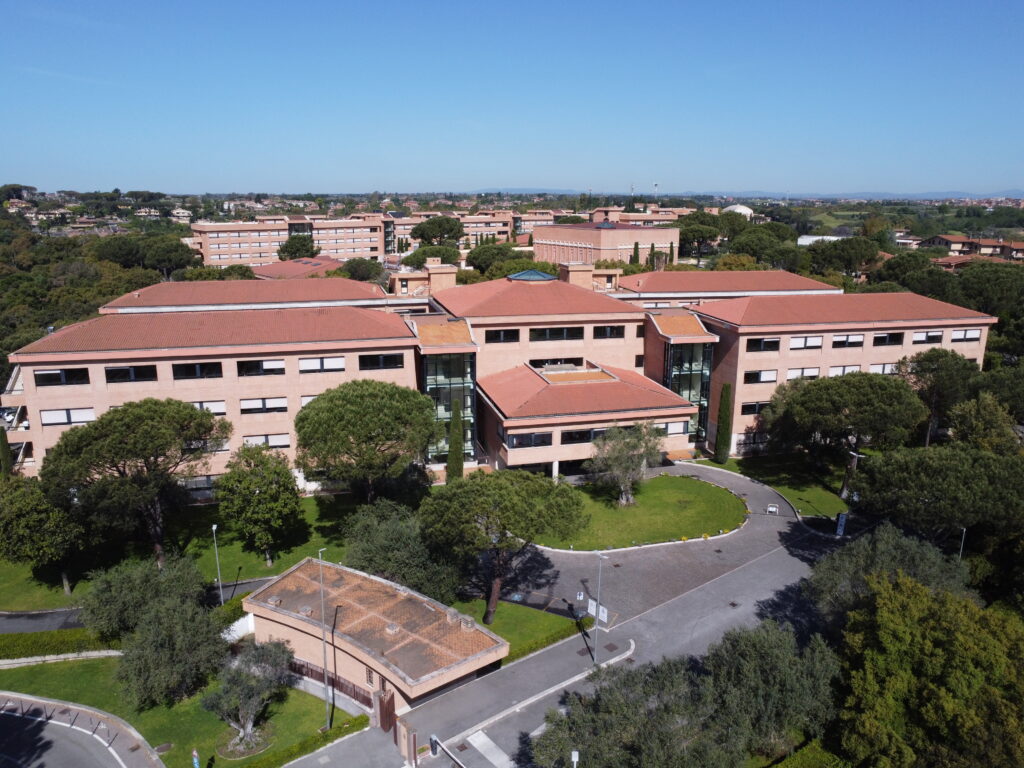

The European University of Rome was founded in 2005 with the aim of contributing to the consolidation of Catholic culture in a country with a strong Christian tradition like Italy. Photographs: EBU
What are the main ethical, educational, and technological challenges that a Catholic university currently faces in the education of its students? How does the UER address them?
Our era, like every historical period, faces challenges of an anthropological, cultural, ethical, social, and economic nature. The university constitutes a space where these challenges converge and where contextualized responses and approaches are sought. I would highlight three major challenges:
The first is of an epistemological nature: the acceptance in the university environment of the analogy of knowledge, a topic frequently ignored but widely addressed by Pope Benedict XVI. It is about recognizing the validity of knowledge of reality that transcends mere experimental science, equally valuing the knowledge coming from philosophy and theology, disciplines with different but equally legitimate methodologies. In other words, it is about embracing what Pope Ratzinger called “open reason.”
The second challenge is that of artificial intelligence. Pope Leo XIV’s encyclical offers a very valuable reflection on this issue, emphasizing that the dignity of the human person must prevail over the benefits—undoubtedly numerous—that new technologies bring.
The third is that of a youth that projects itself into the future with growing restlessness. The current global situation—marked by armed conflict, cultural confusion, and threats to peace—generates existential uncertainty. Therefore, it is essential that the university provides students with psychological counseling, academic tutoring, human support and, for those who wish, spiritual guidance.
How does the EBU contribute to the common good and the development of a more just, supportive and humane society?
As the Latin tradition expressed it: “Opus iustitiae, pax” (the work of justice is peace). Building peace requires working for justice: recognizing the unique and irreplaceable value of each person, respecting their fundamental rights, and, from a Christian perspective, seeing in every human being the image of God.
While scrupulously respecting each student’s religious, ideological, and intellectual freedom, the University integrates into its curriculum subjects of “comprehensive education” that broaden academic horizons to include philosophy, anthropology, ethics, and professional conduct. The religious phenomenon, with particular emphasis on the fundamental contribution of Christianity, is considered an activity of human beings open to transcendence, and the contribution of Christianity to Western civilization is valued.
This training is complemented by social responsibility programs. The University maintains agreements with more than sixty organizations dedicated to the care of children, the elderly, immigrants, and the sick. These programs allow students to experience social service and understand the realities faced by those who experience vulnerability, illness, and exclusion.
In this way, the European University educates a youth aware of its future responsibility in building a more just, equitable and supportive society, based on humanistic values where the historical and current contribution of Christianity is duly recognized.
What specific contribution does the EBU offer to the dialogue between faith, reason, science and culture in the contemporary world?
Teaching, research and social projection activity constitute by nature a permanent dialogue between science and culture, between the academic and professional spheres, between generations and between diverse conceptions of reality.
As a Catholic-inspired university, we especially aim to strengthen the harmonious relationship between faith and reason. To this end, we offer a postgraduate program in collaboration with the Regina Apostolorum Pontifical Athenaeum dedicated to the dialogue between reason and faith. I myself propose a course on “Christian Anthropology in the Face of Science” that explores these intersections applied to fundamental topics of anthropology.
However, our most distinctive contribution as a newly founded institution lies in promoting knowledge that is not self-referential, but rather oriented toward the integral good of the person. Therefore, the centrality of the human person, understood in the Christian tradition as the image of God, constitutes the foundation of all our academic initiatives.
Our most peculiar contribution as a recently founded institution lies in the promotion of knowledge that is not self-referential, but oriented to the integral good of the person. Therefore, the centrality of the human person, understood in the Christian tradition as the image of God, constitutes the foundation of all our academic initiatives.
On this path, we faithfully adhere to the guidelines that Pope John Paul II established for Catholic universities, that of dedicating themselves to the search for truth, recognizing that there is no opposition between faith and reason, but rather differentiated but complementary fields of knowledge.
Thus, at the European University, we seek to revitalize the universal humanism that inspired the founding of the first universities in the Middle Ages, many of which enjoyed the decisive support of the Church. We are therefore driven by the conviction expressed by the Pope himself in the encyclical Fides et Ratio: “Faith and reason are the two wings on which the human spirit soars to the contemplation of truth.” For this reason, the University is not afraid to explore avenues of dialogue between the path of science and the path of faith.
About Father Pedro Barrajón, L.C.
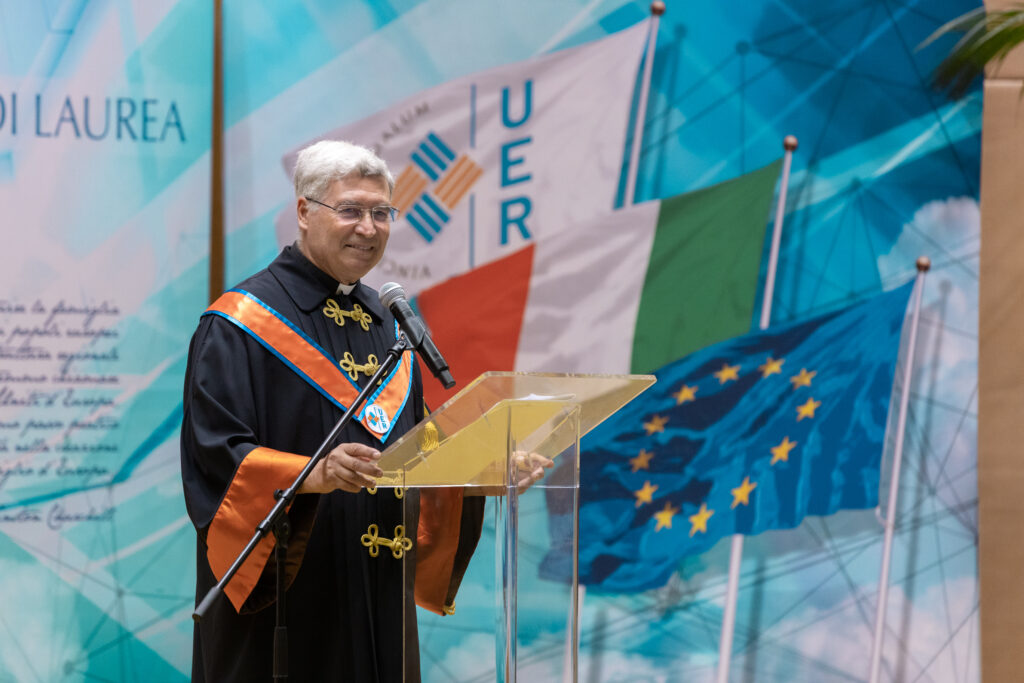
Father Pedro Barrajón Muñoz, L.C., is a priest of the Legionaries of Christ, a theologian, and an academic specializing in dogmatic theology. He has carried out much of his teaching and research at the Pontifical Athenaeum Regina Apostolorum in Rome, where he was rector from 2006 to 2013 and a tenured professor of Dogmatic Theology since 2000.
In addition, he has directed academic initiatives linked to the Sacerdos Institute and has taught courses on philosophy, theological anthropology, grace, Christology and spirituality in various training centers in Europe and Latin America.
His career combines university work, priestly formation, and theological reflection in service