Portuguese
In Christ and Christ in me
Saint Jerome thus remembered a friend of his: “the clerics are called so either because they belong to the Lord, or because the same Lord is their property, that is, the wealth of the clerics. Thus, the cleric is the Lord’s property as he has the Lord as his property, and must present himself as such, so that he himself may possess the Lord and at the same time be possessed by the Lord” (Saint Jerome, Letter to Nepociano, on the life of clerics and monks, 5). This advice from Saint Jerome has a great spiritual strength for me at this moment: to be a priest is to have the Lord as the only wealth and at the same time to be the Lord’s exclusive property for the good of His Church.
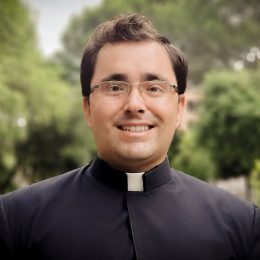
I was born on March 7, 1992, in Candeias-MG, Brazil. I am the eldest of two children, and my parents have always been very Catholic. Since I was able to reason, I already imagined myself as a priest. Of course, I had to let time mature that idea, or not, as some saw it simply as childish notions. One day, during a weekday Mass at my parish, I providentially met some consecrated women from Regnum Christi passing through my town. They asked me if I wanted to be a priest, and I said yes. Later, through a godmother of mine from Regnum Christi, Aparecida Cardoso, I met Father Ángel Llorente LC, who guided and accompanied me in my early vocational steps. From the beginning, I found great support in my parents and immense faith in my decision to leave home so young.
On January 3, 2005, I entered the São Paulo apostolic community, and as a 12-year-old boy, everything was new to me. I learned many things with the desire to live my path to the priesthood intensely, although it was long. I am grateful for the accompaniment and patience of so many priests and brothers who were my formators during the five years of minor seminary. Like in all stages, there are struggles, doubts, tests, but what must not be lacking is the certainty that Christ had a plan for me.
My two years of novitiate, the first in Brazil and the second in Colombia, were a time of great maturity in my response to the Lord. Through the novitiate’s dynamics, I experienced that if I did not lay the foundation of my religious and then priestly life, the entire building could collapse. The foundation is friendship with Jesus Christ, sincere, authentic, personal. On one hand, it is the experience of an encounter with Him; on the other, it is the responsibility to proclaim Him, to bring Him to those who need Him and do not know Him. Knowing Christ is not possessing Him for oneself, but proclaiming Him with all our strength and human creativity. The more we proclaim Christ with our lives and works, the more we get to know Him, because He, proclaimed by us, always challenges us.
Later, my formation continued in Salamanca, Spain, followed by philosophical studies in Rome. I can say that Legionary formation is very multifaceted. Personally, I consider that sacred studies combined with humanistic studies are an important tool to form religious and priests—not as “warehouses of knowledge,” but as men prepared to understand, dialogue, and love the missionary and evangelizing challenge of our time. Everything we learn in seminary is meant to be useful for the Legion, for the Church, for souls; it is so that Christ may transform, through us, this world and the hearts of every man. Therefore, amidst all the vicissitudes of the formation period, this is the essential that remains forever in God’s heart: that the time and energy invested—by me or by my formators—alongside prayer and the support of many, was not in vain. The grain of wheat fell into the ground and will bear fruit.
However, the most challenging stage for me was the three years of apostolic practice. It was like an engagement, a period of mutual knowledge between two people. I got to know more about the Legion and Regnum Christi, and at the same time, the Legion got to know me. Because, deep down, my priestly life must always be a giving, a going out, because no one becomes a priest to live closed off, comfortable, but to be “property of the Lord” and, therefore, to serve His people. I spent two years working as a formator and director of studies at the Venezuelan apostolic community. The material, social, and political circumstances were not the best, but they helped me mature many things. I must say that the greatest richness I found there, which helped my heart grow as a future pastor, is its spontaneous, close, religious, and generous people. In my third year of practice, I moved to Medellín, Colombia, to work with teenagers at Colegio Cumbres. I cannot recount all the experiences lived there, but I share something important: at that point in my vocational journey, supported by my superiors and many people I met, God always confirmed that He had chosen me to be His instrument, that I should be docile and leave myself in His hands, because He never disappoints.
Then, in 2020, my theology studies in Rome coincided with a nearly pandemic situation. But that did not diminish my desire to continue my formation serenely and with trust in the Lord because, deep down, I wanted to give my whole life to the Lord and His Church. These last years of initial formation are like a funnel, where we must refine and focus on what truly matters in the journey of life. Kierkegaard spoke of “a purity of heart that consists in having only one idea.” For me, this idea was strengthened and matured through prayer, study, and the serene, close accompaniment of my formators, who helped me in the final stretch—Fr. Christopher Brackett LC and Fr. Gonzalo Rebollo LC—and also through living fraternity, especially with those forming the same generation. There are good and well-prepared people, I know that. It is a joy to know I do not take this step alone; we are all supported by the Lord and support each other.
Saint Ignatius of Loyola speaks of a foundational experience that leaves an indelible mark on a person’s spiritual journey. When I did my spiritual exercises over a month in 2020, I remember very little of what I prayed there. Only one experience stayed with me. One day, during the exercises, while I was cleaning the chapel, I was assigned to clean the confessional booths. I was inside the confessional, in the part where the priest sits. At a certain moment, I looked carefully at the small space where I was, and I thought: soon I will be here… and I will forgive. Yes, Christ will forgive, I will forgive. I in Him and He in me. I couldn’t hold back tears. It seemed as if time stopped inside that confessional because mercy is eternal, and only mercy can halt human time—sometimes burdened with misery, sins, weakness; that time, that man, that soul, embraced by mercy, can once again fix his gaze on God the Father and His eternal love. And as if that were not enough, in that foundational experience, what Saint Jerome wrote was fulfilled: I am property of the Lord; the Lord is my only wealth. I in Him and He in me.
At the threshold of the gift of the priesthood, I am very happy. God has placed wonderful people in my path, without whom I might not be here. My gratitude to my parents, Célio and Nilza, and my brother, Adelson, who have always supported me with prayer. To my godmother Aparecida, who did so much for me on this long journey. To Fr. Ángel Llorente LC, priest and friend, who supported me from the beginning and was always present with his kindness and closeness. To so many friends and acquaintances who have crossed my path, to all I express my sincere gratitude.
The priesthood is not the endpoint but the starting point. The Holy Spirit—who, in Saint Basil’s insight, is “the craftsman or artist of harmony”—grant me the grace to be property of the Lord and to have the Lord as my only wealth, so I may serve men with a merciful heart, freely dispensing the mysteries of God.
Brief biography:
Father Celso Júlio da Silva LC was born on March 7, 1992, in Candeias-MG, Brazil. He entered the Arujá Vocational Center-SP on January 3, 2005, and completed his primary studies in 2009 at the Porto Alegre Vocational Center-RS. He began his Novitiate on March 7, 2010, in Arujá-SP. The following year, he was transferred to the Medellín Novitiate, Colombia. He took his first religious vows on January 28, 2012, at the minor seminary in Medellín. That same year, he supported as a formator and teacher at the Arujá Vocational Center, SP. He completed Classical Humanities studies in Salamanca, Spain, in 2012, and then earned a bachelor’s degree in philosophy from the Pontifical Athenaeum Regina Apostolorum from 2013 to 2016. After completing philosophy, he did apostolic practices from 2016 to 2018 at the Mérida Vocational Center, Venezuela, as a formator and prefect of studies. From 2018 to 2019, he was an instructor of formation and assistant of ECYD at Cumbres School in Medellín, Colombia. In 2020, he began his theology studies in Rome, and on January 3, 2021, he made his perpetual vows. During the summers of 2021 and 2022, he supported as an assistant philosophy professor at the Seminary María Mater Ecclesiae in Brazil. He was ordained deacon on July 9, 2022, at the São Paulo Metropolitan Cathedral. His ministry has been dedicated to teaching, and he is currently studying for a license in theology at the Institutum Patristicum Augustinianum in Rome.